Sabotaging Difficult Conversations

Sabotaging Difficult Conversations

Sabotaging 

difficult

conversations

Sabotaging

Difficult

Conversations

BY DR. DARRELL BOCK
DALLAS THEOLOGICAL SEMINARY

My dear brothers and sisters, take note of this: Everyone should be quick to listen, slow to speak and slow to become angry, because human anger does not produce the righteousness that God desires. – James 1:19-20

I  n our first blog post, we covered the goal in a difficult conversation: mutual understanding of each participant’s viewpoint. This is not the same as agreement but a shared understanding about the nature of the conversation and any differences.  

Assessment of what to do follows this understanding. It requires a commitment to truly listen to the other person. To go into a difficult conversation to simply win usually results in no real conversation at all.  

In this post, we will consider what often undercuts effective conversations. Anyone who watches TV and our current examples of discourse will see these regular violations of good conversations. 


What does not work well in conversations, even difficult ones?

There are at least five things that can take a conversation down. If we are honest, we all use these methods. They are forms of deflection and usually indicate something we perceive as needing protection. So, unfortunately, we go there.  

In our conversations, we either move against someone, withdraw from real engagement or move toward someone. I can move toward a person without agreeing with them by respecting their perspective, hearing it and being able to restate it so the other person can say, “You heard what I have said. The building of such trust and respect will help assess what can or needs to be done 

But at least five things can stifle reaching that goal. 

The Quick Confession with a Pivot


 Someone brings up something that is a problem for the view I hold. My response involves quickly acknowledging the problem (the confession). But then I immediately pivot by pointing to a shortcoming of the other side. I call this the “yes, but the your side is worse” response. This fails to help for two reasons. 


  1. It refuses to focus on what might be contributing to the problem or issue from the end I support. It may even pretend that my side’s role is small or insignificant when it may not be. 
  2. Even though there is an issue on my side, the pivot ultimately downplays my side’s role or disrespects what has been raised. It immediately tries to pin the majority of the blame elsewhere. That is not a move toward understanding. Instead, it blames. It puts assessment in a dominant and often premature place. 
The Curse of Labels


In a word or two, we label an idea negatively, play “Taps” over it and put it to rest by deeming it unworthy of more detailed comment. We label something as liberal or conservative, socialist or fundamentalist, blue or red. The list goes on 

Using labels ultimately destroys any possibility to move forward. It’s a lazy attempt at engagement. They dismiss the person behind it.  

Jesus used labels sparingly and carefully. By not dismissing Zaccheus as a “tax collector” or the woman at the well as “a divorced Samaritan,” Jesus turned everyday conversations into opportunities for eternal significance. 

Assigning Motive


Another tactic is to assign a motive, usually a negative one, to the position being presented. Often this is done to suggest insincerity or a disingenuous motive. The goal is to suggest the idea has no merit or basis because its intent is illwilled. To truly know the intent of another person requires a prophetic gift many of us lack.  

Assuming motive communicates a level of disrespect. It suggests the real reason for something is not what is being presented.  

This also is a tricky category because sometimes motives are mixed and not always clean. However, to start here is really raising questions about integrity that may not be the case. This is a form of moving away from another in a conversation.

Thinking Poorly or Skeptically about Seeking Common Ground


This category is subtle because it is rarely expressed but operates underground. It is the sense that if I move toward someone and acknowledge the merit of a point, they interpret it as a defection from my view. 

Another variation of this is to think in an allornothing binary mode. This approach says there are only two views when a series of options might exist. Such thinking works against a move toward mutual understanding 

An initial move toward understanding is rarely a negative move in a difficult conversation. Remember, understanding is not the same as agreement. Especially for Christians who hold to the truth of the Bible and stand firm in their convictions, understanding another person’s viewpoint is a loving desire to comprehend the exact nature of a disagreement.  

We should not assume we know the problem. Understanding says you and I agree that this is the content of what you are saying and why. Agreement says I am affirming what you are saying and why. That is an important difference. Mutual understanding sets the stage for a better level of discussion when assessments are undertaken.  

Much dysfunction is twosided. Limiting options or hesitating to see your role as contributing to a problem often can contribute to a breakdown in making a conversation profitable. 

Tribalism


Tribalism says I can never show weakness or acknowledge a shortcoming. I can never give ground, not even a few inches. This approach shuts off being self-critical and willing to grow. It almost assumes an omniscience none of us possesses. It is treated as a sign of weakness or defection from my side. It almost always works against a profitable conversation. It misreads loyalty to a side with a necessity to never give ground.  

An important counterexample involves the prophets. One could say they were very pro-Israel. They loved and believed the cause of the people of God, their people, their tribe. They were tribal in that sense, but they also were extremely self-critical. They were honest about when their side came up short. They recognized growth only happens when shortcomings are faced and dealt with. When I get so tribal that I cannot see legitimate fault or even consider it, I am setting myself up for failure in terms of real growth. 

These are some ways we sabotage conversations. They turn us into poor listeners. 

We still have two other themes to cover. One is what we can do to advance conversations, and the second is how holding our convictions enter into our conversational engagement. We’ll cover those next week 

Hopefully, seeing what we do to undercut conversations can help us better engage in fruitful conversations by avoiding those things that prevent us from getting there. 

Dr. Darrell Bock is senior research professor of New Testament and executive director for cultural engagement at Dallas Theological Seminary. He hosts The Table Podcast, leading discussions related to God, Christianity and culture.
Better difficult conversations setting the table

Better difficult conversations setting the table

Better Difficult Conversations

Setting the table

By Darrell Bock – Dallas Theological Seminary

My dear brothers and sisters, take note of this: Everyone should be quick to listen, slow to speak and slow to become angry, because human anger does not produce the righteousness that God desires. – James 1:19-20


Sometimes the most substantive conversations we have are the difficult ones.  

Whether we’re talking with a child, a spouse, a colleague or discussing core life values,  we often find ourselves engaging with someone who disagrees about what is going on or what needs to be done. This also is the case for conversations about religious differences.  

Christians tend to think about such conversations by simply asking how another person’s religious viewpoint does not line up with the Bible. This is important to know – and have an awareness of – to know where the faith discussion fits.  

However, there is another way to have such discussions that can help in engagement. It is not only to learn the beliefs of another faith but why someone might be drawn to give their life to this way of viewing faith.  

I call this getting a spiritual GPS on a person – finding out with full curiosity what makes them tick and what is driving their spiritual quest.  

How does this person approach faith? 

As the conversation begins, the goal is to determine where the other person is coming from in approaching faith. Rather than being concerned with where you are in faith, focus on where your conversation partner is. Then work from there.  

How does the gospel speak to that approach? 

In pursuing answers to these questions, you can then explore how the gospel can speak into those inclinations. However, to get there, you must understand how difficult conversations work if they are going to go somewhere.

After Sandy recovered, she and her husband had three more children. They celebrated birthdays, Christmases, and school graduations. Life seemed hopeful.

But their journey of grief was not over.

As Sandy’s daughter grew into a young adult, she began to abuse drugs. Sandy prayed persistently and shared her faith.

Tragically, Sandy’s daughter died at the age of 21. 

The couple was devastated. Once again, they found themselves mourning the loss of a beloved child. 

As Sandy and her husband sorted through their daughter’s belongings, they discovered a journal with a small cross. The journal included Scripture, a plan of salvation and these simple words:

“If you think it’s funny that I have this cross, know this … I belong to Jesus.”

Once again, Sandy experienced God’s gracious comfort that she would see her child again.

Learning the Skill

Developing skill at having difficult conversations is hard because we must unlearn certain habits. We must be clear about how to change the way most of us engage when the conversation gets hard.  

This blog is about setting the table for a better difficult conversation. In later blogs, I will look at what derails and what advances such conversations. Our instinct in difficult conversations is to defend turf, to be right. But that is counterproductive. It’s not because we should not defend our views, but because that defense is harmed when we start with the conclusion. In such circumstances – and this is common in difficult conversations – we do not have a constructive conversation but simply a defense.  

You can test how you are approaching a conversation by whether you are actually making an effort to listen and understand your conversation partner or forming how you will rebut what he or she is saying. 

Here are some guidelines for giving yourself a chance to have a good conversation. 

1. Clarify the conflict

It is important to understand each other and the exact nature of the disagreement. This needs to be mutually agreed upon as an initial goal, if possible. This means being able to repeat what your conversation partner is saying in ways where they say, “Yes, you understand me and what I am saying.”

2. Articulate both viewpoints

Understanding and being able to gain understanding does not equal agreement. They are distinct. In other words, moving to a mutual understanding is not compromise nor is it leaving behind convictions. It is simply laying the groundwork for a better substantive conversation.  

Understanding means you can articulate what another is saying and even why without necessarily agreeing this is so. Because each person in the conversation takes on this responsibility to try to make sure a good conversation is taking place, each person will get their chance to articulate where they are coming from and why.  

In this phase of a conversation, there is no room for rebuttal or for changing the subject by adding another element to the conversation. (That move often can derail any progress by complicating the conversation.) Rather, the goal is to align where each person is and why. With alignment, both of you can pursue either what needs to be done to fix things or determine exactly why you disagree. This puts you in a better place to assess what is going on.  

3. Agree to assess the issue

Having a better understanding of each other puts you both in a better place to make an assessment about what is going on between you. When you can agree where the actual differences exist, you are in a better place to figure out what can come next, even if it ends in an assessment that you value different things and thus come to different conclusions. 

All of this assumes our first responsibility in difficult conversations is to give an initial priority to really listening. I usually know where I stand and why, but what I may need to learn is why someone is coming from a different place than I am. 

These are initial points about difficult conversations and how to engage in them with the hope of progress. This sets the table with a chance of getting somewhere. There are other factors, such as what we do to undercut such progress and what we can do to advance the chance for progress. Those are the topics to come.

Dr. Darrell Bock

Dallas Theological Seminary

Dr. Darrell Bock is senior research professor of New Testament and executive director for cultural engagement at Dallas Theological Seminary. He hosts The Table Podcast, leading discussions related to God, Christianity and culture.

Forgetting what lies behind

Forgetting what lies behind

Forgetting what 

lies behind

BY BENNETT ROLAN | BSF BLOG EDITOR

Forgetting what lies behind

BY BENNETT ROLAN | BSF BLOG EDITOR

I n the 90s, Maureen Wong was part of an elite team assigned to promote confidence in Hong Kong as the territory made a historic shift from British to Chinese sovereignty in 1997. After 150 years under British authority, tensions were at an all-time high as negotiations between the two political powers escalated.

“It was an exciting time,” Maureen said, “but also demanding and challenging.”  

In 1996, just a year before the transition, Maureen and her family moved to Hong Kong where she played an integral part in the territory’s new administration. 

On the outside, Maureen had it all together. She was competent, successful and on the administration’s fast-track. But at home, Maureen’s life felt chaotic. 

In this season of turmoil, Maureen discovered Bible Study Fellowship. During a pilot study of Philippians, God gave Maureen what she needed most: spiritual confidence rooted in God’s Word. 

“Looking back, it wasn’t easy,” Maureen said, “but God provided for me and protected me through His love. I found joy and peace, and I had energy to do the things I had to do during that time. I couldn’t have done that without God’s strength and the constant awareness of His presence and Holy Spirit.” 

With a renewed focus on Christ, Maureen committed her gifts and abilities to promote God’s glory. Though He didn’t change Maureen’s circumstances, God transformed her heart.

“Not that I have already gained this or am already perfect…But this one thing I do: forgetting what lies behind and straining forward to what lies ahead, I press on toward the goal for the prize of the upward call of God in Christ Jesus.”  – Philippians 3:13-14

Pressing on toward the goal

In 1998, Maureen had a difficult decision. She could continue her career, earning status and high income, or leave the field altogether by moving to London with increased time for family and God. 

She chose the latter.

“Whatever were gains to me I now consider loss for the sake of Christ. What is more, I consider everything a loss because of the surpassing worth of knowing Christ Jesus my Lord, for whose sake I have lost all things.”  – Philippians 3:7-8

“I had no plan as to what I was going to do,” Maureen said. “I knew that I needed God’s Word to guide me, and I prayed that BSF would be accessible somewhere in London.” 

In answer to her prayer, BSF was launching a Day Women’s Class in London and needed a class administrator with Maureen’s skills. 

“I became CA straight away,” she said. They (BSF leadership) said I was God’s answer to prayer because they didn’t have anyone in London who was familiar with BSF. But I knew this was God’s answer to my prayers as well. 

Maureen was essential in establishing London’s BSF program and helped to start an Evening Women’s Class. But with time on her hands, Maureen was willing to serve the Lord beyond BSF. 

The upward call

While filling her time with family, church friends and BSF, Maureen believed God could use her skills in a broader way. 

“I came back to London and had nothing to do. I was attending church meetings, going to church, hanging out with friends and enjoying the good life,” she said. “In studying God’s Word, I learned to be open to whatever ministry God gave me.” 

When a former colleague asked Maureen to help establish a struggling non-profit, she said yes immediately. Founded by former gambling addicts, The Christian Centre for Gambling Rehabilitation provides emotional support and life-skills training that begin with the gospel. 

“I initially thought it was a short-term role, registering the organization as a charity,” she said. “I quickly realized that they needed someone to help them with administration and government compliance. They didn’t know how to manage an expanding organization, and they just didn’t have time.” 

In this new volunteer role, God used Maureen’s skills and previous professional network for His glory. 

“God made use of my past experience, enabling me to do the work He had called me to do at that time,” Maureen said. “I was privileged to see first hand the people who had been helped, their desperate lives turned around and rebuilt. These people began to flourish, and I saw God’s hand over each one of them.” 

Working for a fledgling ministry meant budget constraints and uncomfortable working conditions in an unfamiliar London neighborhood. 

“We don’t have a bright air-conditioned office,” Maureen said. “And I must admit, these were not the people I was used to hanging out with.” 

But God called the woman who once worked among Hong Kong’s top officials to serve the broken men and women of London.  

“Serving God in the ministry He calls me to is miles better than the one I would have chosen using my head,” Maureen said. Whatever achievement I see is not mine, it’s God’s. It takes a lot of patience, even a lot of time, but to see God change people’s lives so dramatically is most encouraging and rewarding.” 

The prize

Maureen doesn’t describe her move to London as a sacrifice. Instead, she says, “It was true that I had to give up certain material things, but when God opens a door, responding positively turns out to be the right thing to do.” 

Like the apostle Paul, Maureen is simply an ordinary person with faith in an extraordinary God. Her story is a beautiful testament of how God’s plan reaches beyond our own understanding. When we trust the Lord with our jobs, families and circumstances, He is faithful to make our paths straight. For Maureen, that path led in an unexpected direction, but delivered deeper joy and intimacy with Christ.  

When we say “yes” to God, His path may seem unconventional, but we never have to walk it alone.  

“…Being confident of this, that He who began a good work in you will carry it to completion until the day of Christ Jesus.”  – Philippians 1:5-6

Exploring God’s promises in the Promised Land

Exploring God’s promises in the Promised Land

Exploring God’s promises in the Promised Land

Upcoming Israel Trips with BSF

May 17 – 30, 2019

Dr. Carl Laney

View Brochure

Sign Up

May 31 – June 12, 2019

Dr. John Hannah

View Brochure

Sign Up

October 1 – 13, 2019

Dr. Mark Strauss

View Brochure

Sign Up

BY BENNETT ROLAN | BSF BLOG EDITOR


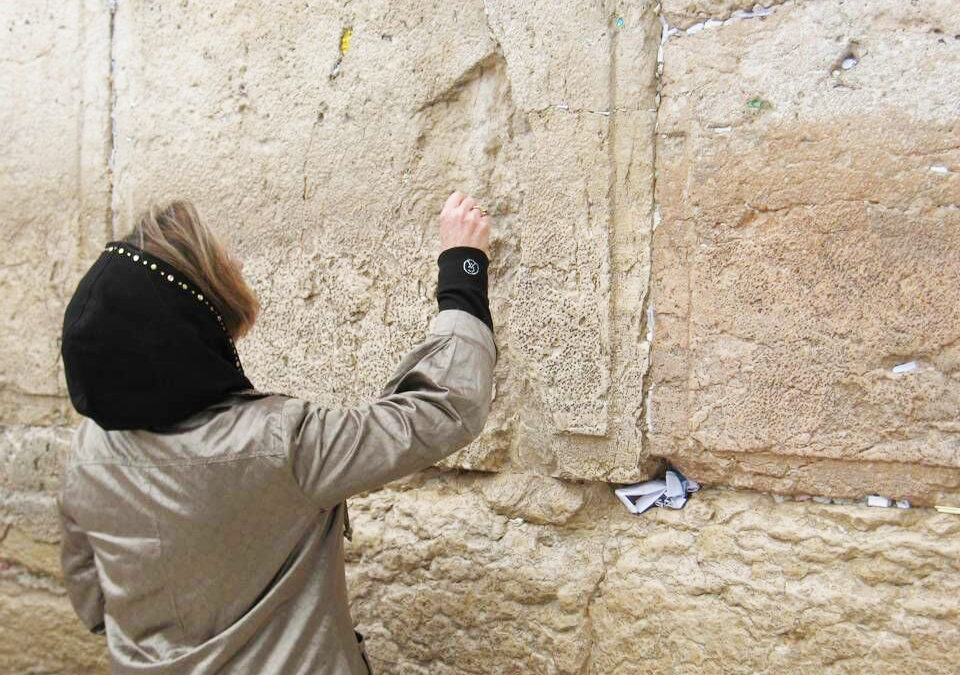
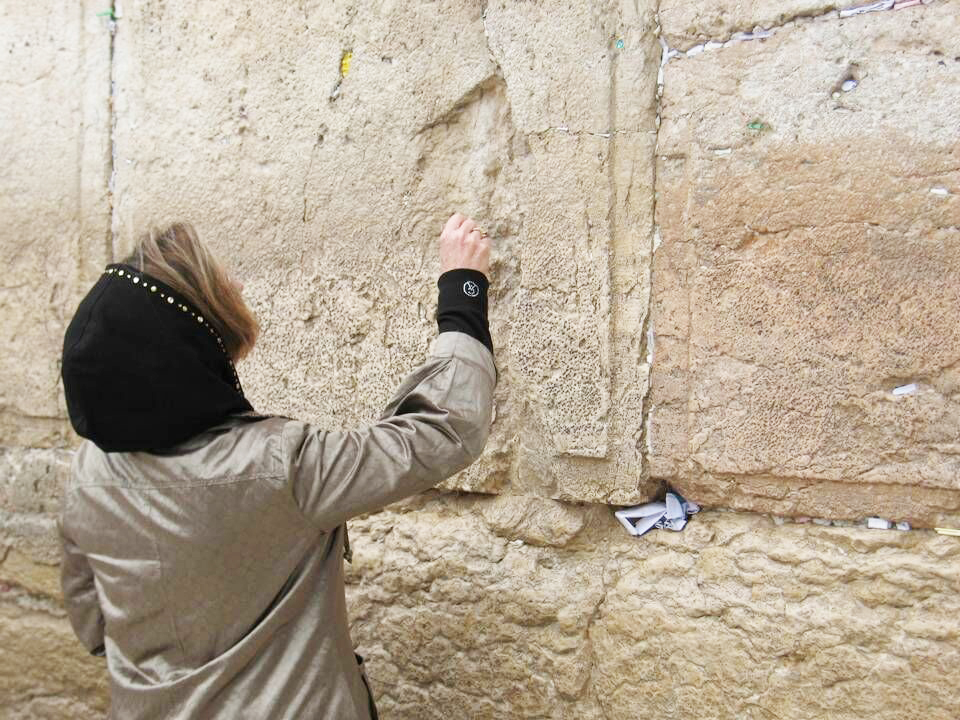
S  usie Rowan slipped her prayer request between the giant stones of Israel’s Western Wall. Taking a step back, God’s presence was almost overwhelming as she reflected on the history of that holy place. It represented the fullness of God’s plan: His faithfulness to Israel, His sacrifice on the cross and the final restoration still to come.

And there, Susie’s request rested safely, tucked in the wall.  

“To know that Jesus would have also been right there,” Susie said, “I experienced His peace and presence, knowing that He heard, and He would answer those prayers. Not just for my good, but for the good of the whole, the good of many, which would also be for my good as well.”

As the executive director of Bible Study Fellowship, Susie has witnessed God’s amazing work in and through His people worldwide. But in 2011, Susie experienced the truth of God’s Word in a new way during her first visit to Israel on a BSF Trip.

“It’s something I wish every Christian could experience,” she said. “Maybe the most memorable site was Gethsemane. One of the olive trees was even thought to have been there at the time of Jesus. You live through His prayer and begin to feel the agony of anticipating the cross. It’s a very quiet time of reflection. Then you walk into the church, called the Church of Nations, on the Mount of Olives. People are just worshipping together, in so many different tongues and languages. It was an extraordinary experience.”  

Leaving the church, the group stood and surveyed the Kidron Valley where Jesus walked and where David wrote in Psalm 125:2, “As the mountains surround Jerusalem, so the Lord surrounds His people both now and forevermore.” 

“Your heart really does just soar,” Susie said. “You remember the promise that God has given us, that on the day that’s coming, the feet of Jesus are going to stand on the Mount of Olives and you’re standing there. It’s pretty powerful, pretty emotional.” 

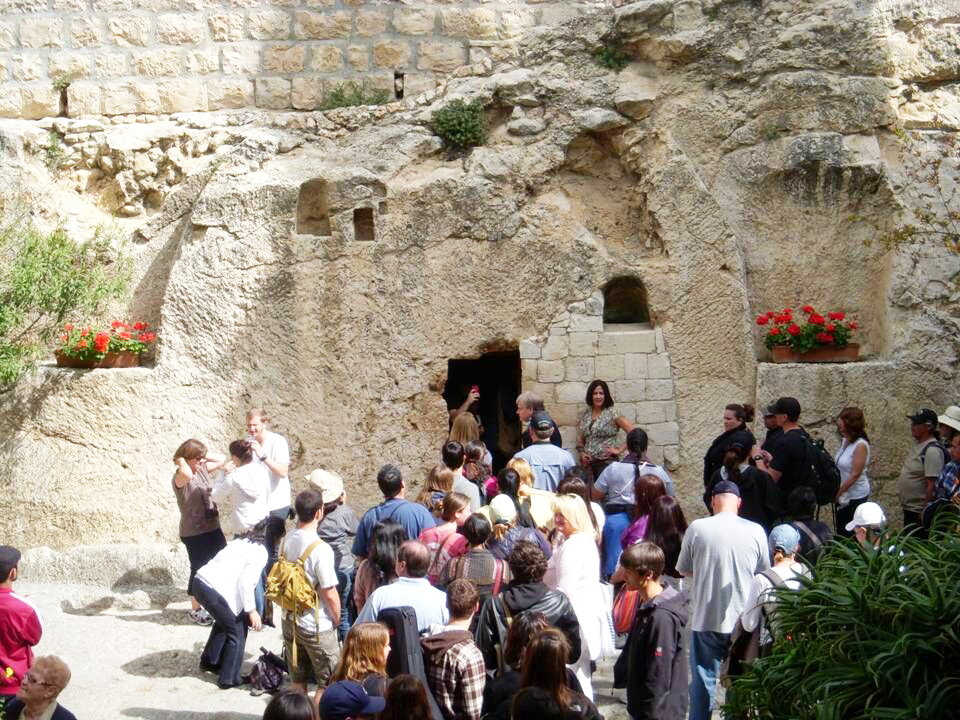
Throughout the trip, while worshipping on the Sea of Galilee, walking on ramparts surrounding the old city or praying at the possible site of Jesus’ crucifixion, familiar Scripture took on a deeper sense of reality.

“I really love cities,” Susie said. “I love their energy and their tension. I’m a city person, so walking through Jerusalem, feeling the Jewish, Muslim tension at the Dome of the Rock was pretty powerful. Thinking through what the future would look like, where a temple could be built to prepare the way for the return of Christ, was extraordinary.” 

Entering the trip, Susie expected to learn from the experts leading the group. But she left with more than just knowledge. For Susie, God’s Living Word came to life in a new way. Since that time, Susie and Roger have already made a second trip to Israel with the BSF Travel Connection tour and are eager for the next opportunity God provides to return to His land.  

If you’re interested in a trip to Israel, several BSF trips are available throughout the year. To learn more about a trip of a lifetime, check it out here.

Susie Rowan at The Western Wall

Roger Rowan on The Sea of Galilee

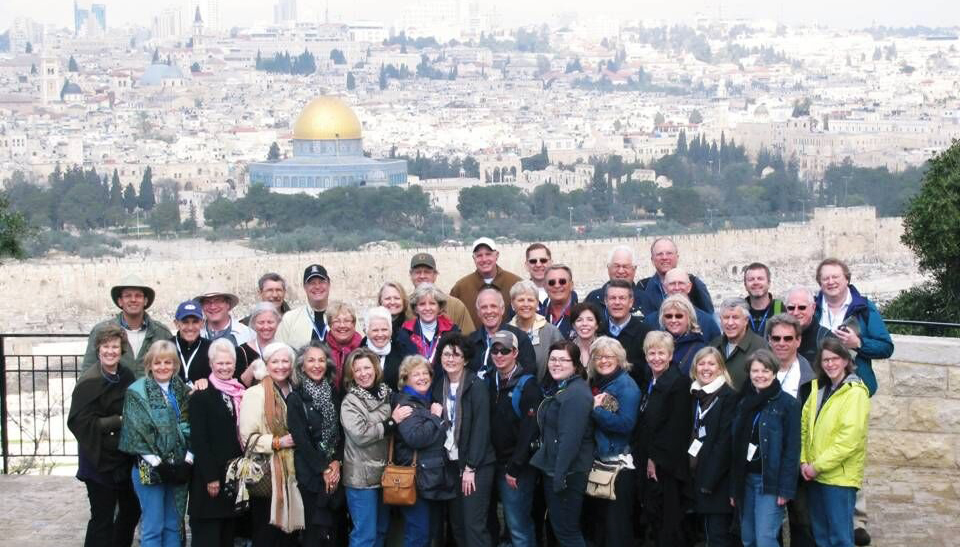
BSF Israel Tour Group

Upcoming Israel Trips with BSF

May 17 – 30, 2019

Dr. Carl Laney

View Brochure

Sign Up

May 31 – June 12, 2019

Dr. John Hannah

View Brochure

Sign Up

October 1 – 13, 2019

Dr. Mark Strauss

View Brochure

Sign Up

The gift of technology

The gift of technology

The Gift of Technology

By Pete Helgren – BSF Software Developer

I smiled as the couple quietly bowed their heads in the restaurant. You don’t see folks pray before their meals very often these days. Then I noticed they weren’t praying: They were taking pictures of their meals with their mobile devices. Ah, the surprises that come with living in the 21st century! As a web developer at BSF Headquarters, I’m more immersed in the technical world than most. Spending my days and nights in the glow of electronic devices makes me think about how technology has crowded our lives.

What should we think of this technology explosion?
Is the news all bad?
Can technology be good?

Since Genesis, tools have been an integral part of humanity’s work. From tilling the soil (Genesis 4:2) to playing music (Genesis 4:22), God’s people use His creativity to develop and nurture a fallen world. Sometimes that creativity has pleasing results. Sometimes the results simply confirm our need for a Savior. Like all gifts and all tools, technology can either be redemptive or destructive. We see the destruction all around us. Let’s look instead at how we can use electronic tools and technology redemptively.

Technology can help us prioritize

Our 21st century lifestyles would be busy enough without technology interrupting our daily lives. Text messages and mobile apps clamor for our attention. E-mail and social media feeds crowd our days. But using technology wisely saves us time. A quick text of assurance can relieve anxiety. A quick traffic scan saves time on the road. Personal calendars streamline our meeting times.

Technology can also help us plan for the whitespace, the quiet time we need to slow down and listen for God’s still small voice. It’s that time when we put the wind, earthquakes and fires of the day behind us. Believe it or not, we humans need that quiet time. Our brains must sort through and make sense of the daily background noise. Use the tool of technology to help you plan for some quiet time with God.

Technology can collapse the distance between people

Our God is deeply relational. In the Bible, God often interacts directly with His people (Genesis 6:13; 17:1; Exodus 3:4). We know that an all-powerful God could easily solve the problem of sin at a distance. Instead, He chose to dwell with us.

God made us in His image – as personal, moral and spiritual beings. So, connecting with God and each other personally is part of what it means to be human.

Think of all the ways the Triune God could speak to us today. Daily tweets or a text message or two. And who wouldn’t love to have access to God’s Instagram account and the magnificence of Heaven? Instead, God chose to come to us in human form, and communicated that encounter to us through inspired human authors, for human good.

Embrace your God-given relational nature! Whenever you can, join with your brothers and sisters in Christ in a personal, face-to-face way. Text an invite to someone you haven’t been with in a while to join in study, prayer or encouraging conversation over coffee. Linger before or after class or your group meeting to connect. Check to see if a virtual group member lives in your area to put a physical presence on that virtual friendship you enjoy.

Use technology to schedule time to be without technology. Use impersonal electronic communication to meet personally, with someone you care about. The tools we use change us, but they shouldn’t define us. Our identity isn’t found on Facebook, it is found in Christ. So, use the tool of technology, a God-given gift, to conform to His likeness: Set aside time with our Father, seek out others personally to share Christ.

Like any tool, we can use technology for evil or for good. Remember that it IS a good gift from a good God who wants us to spend more time with Him and more quality time with each other, in person, building up the body of Christ. Yes, technology can get in the way. It can use up precious time and put distance between us when we really yearn to be together. But if we use technology wisely, we can grow close to God and to our brothers and sisters who share this love for God and love for His Word.

Pete Helgren

BSF Software Developer

Torn Curtain goes beyond the Iron Curtain

Torn Curtain goes beyond the Iron Curtain

Torn Curtain goes beyond the Iron Curtain

BSF prepared Peggy Sansbury to study God’s Word in her South Carolina class. Years later, God used her BSF training in an unexpected way.

By Bennett Roaln – BSF Blog Editor

After a deep breath and a quick prayer, Peggy Sansbury walked to the podium. Soft light from the windows and fresh paint gave the long-abandoned Nazi interrogation room new life and a new purpose.

In January 2017, Peggy’s South Carolina pastor invited her to speak at a ministry conference in Bulgaria, sponsored by an Eastern European ministry called Mission Possible. As a former BSF teaching leader, Peggy felt comfortable in front of large crowds. But this was different. She wasn’t lecturing to her familiar Day Women’s Class, sharing with long-time BSF friends. Close to 50 Eastern European pastors, their wives and a team of interpreters gathered to hear Peggy speak about biblical marriage.

“I thought, ‘Are they going to accept me, especially as a woman teaching God’s Word?’ But it was amazing how God broke through their hearts, especially in a male-dominated society. I doubt they had ever heard biblical teaching on marriage before, and it was absolutely thrilling to see God work through this particular message,” Peggy shared.

“My role was to sow the seed that marriage should be a loving relationship, where the husband doesn’t dominate his wife, but loves her as Christ loves the Church. I was also blessed to see the wives come out of their little shells of shyness with a new hope that they could respect their husbands and experience joy in the process”

Though Bulgaria achieved its freedom in the early 1990’s, the landscape is still marked by a few dilapidated army tanks and war-torn buildings. Broken-down Nazi vehicles are painful reminders of the German invasion during World War II, followed by 46 years of Soviet occupation. During that time, the Soviet government inconsistently treated Christians with limited tolerance and open persecution.

One pastor at the conference remembers government officials raiding his father’s underground church meetings. As worshippers fled into the night, police ripped his mother’s beautifully hand-sewn banners, hung to help shield the services from authorities. Despite this persecution, church members continued to gather and laid the foundation for a new generation of believers in the area.

“These people came out of the Iron Curtain and have only been free for 27 years,” Peggy said. “Imagine that! I was speaking to first-generation Christians, including a few who were part of the underground church. Everything in their ministry is built on faith, so pure and so strong.”

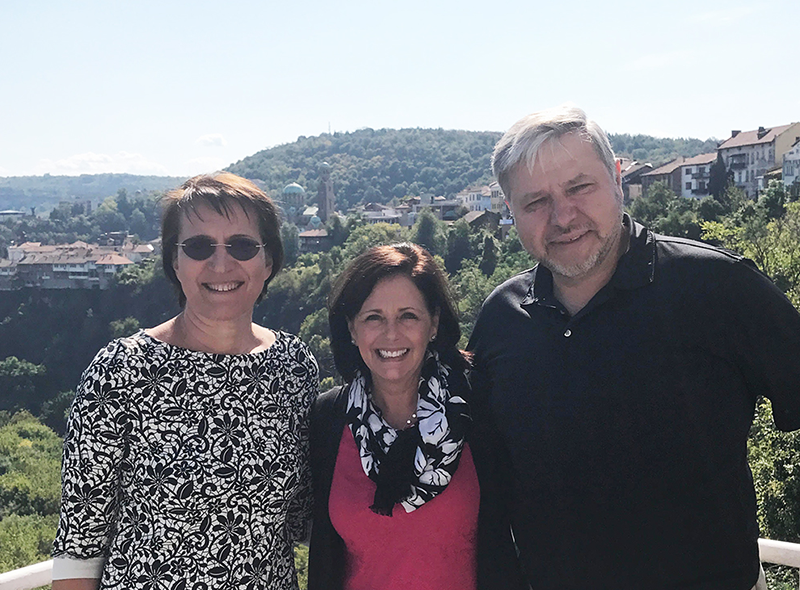
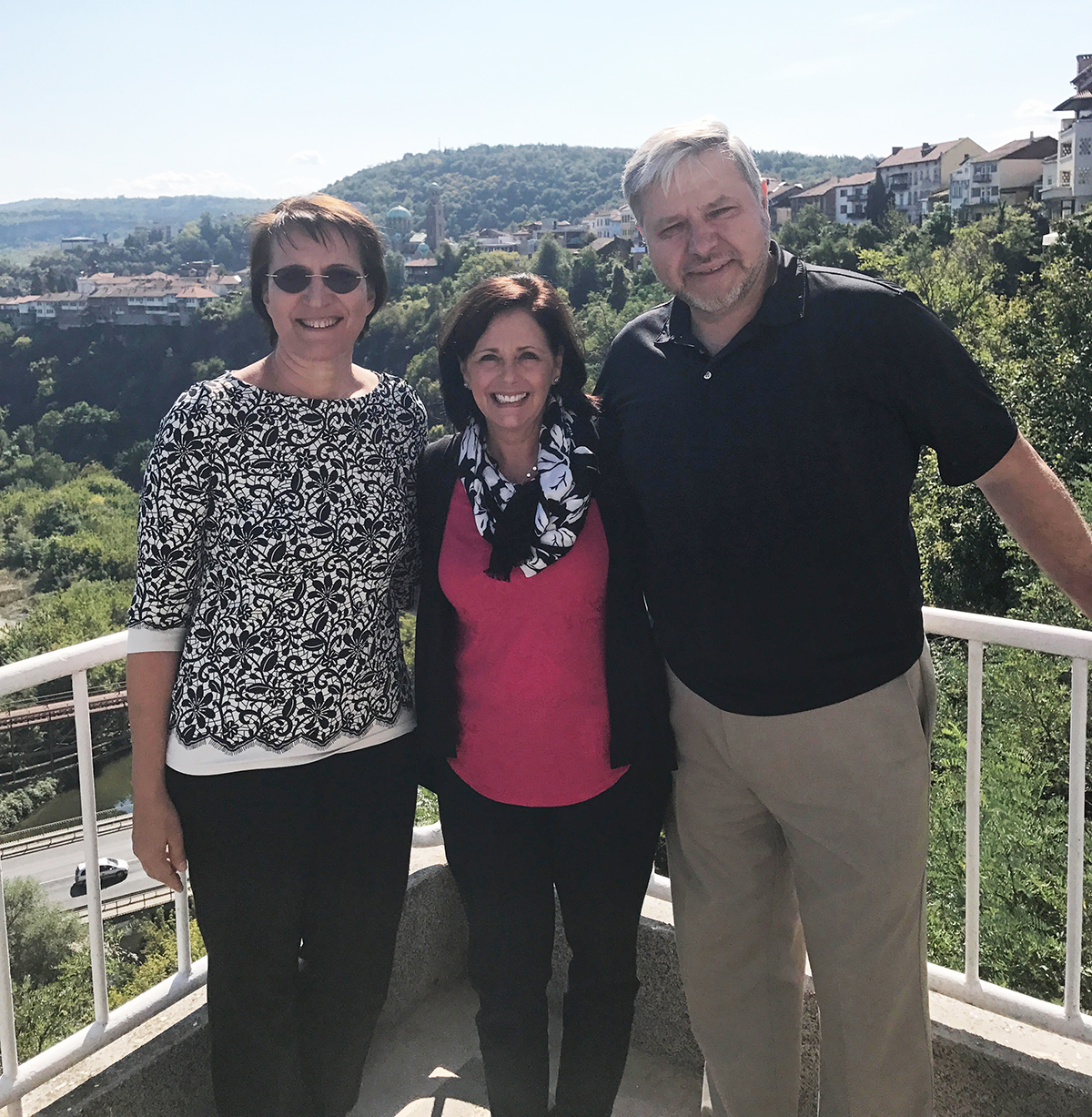
Peggy (center) with the leader of Mission Possible and his wife in Bulgaria.
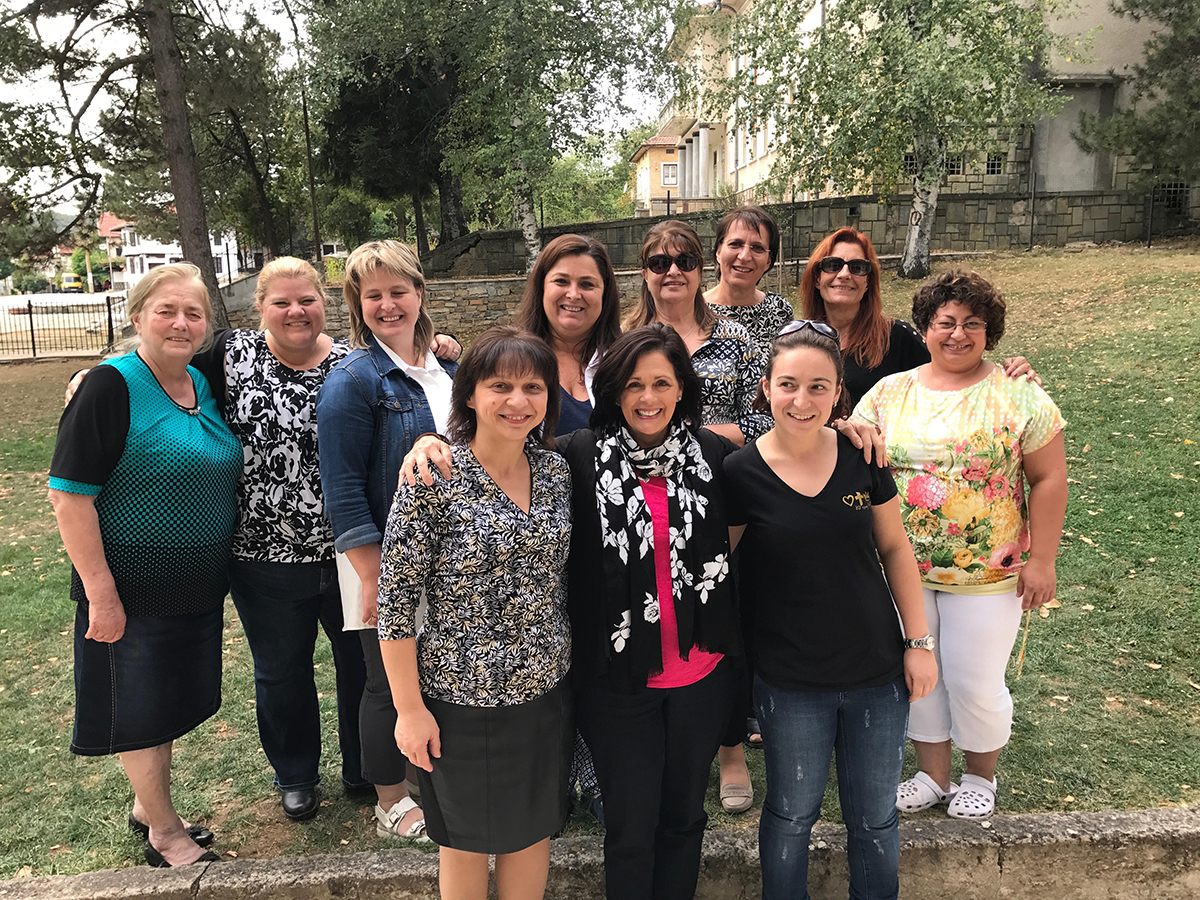
Peggy (front, center) with team members, Mission Possible leaders and local volunteers from the conference.

Separated by language, culture and experience, Peggy wondered if her prepared talk would resonate. But the same Holy Spirit who worked in her South Carolina BSF class spoke into the hearts of her Eastern European brothers and sisters.

“As we worshipped together, it was almost as if we spoke the same language. The Spirit of God gave us an immediate bond. And afterward, we just loved on one another, grabbed interpreters and shared how God was working in their countries and in their personal lives,” she said.

While Peggy bonded with Bulgarian believers overseas, her South Carolina BSF friends prayed for their former teaching leader.

“You don’t think about it while you’re in BSF, but it’s so true. BSF is a season of preparation for a lifetime of ministry,” she said. “I took all the power tools that had been instilled in me through BSF – learning to hear that still small voice as you read the Word, love for God’s Word, homiletics, how to prepare a lecture, how to do research – and I activated them in this new season.”

A season of preparation

In 1989, Peggy’s friend invited her to attend the new BSF Myrtle Beach, S.C., Day Women’s Class. A stay-at-home mom to young children, Peggy was searching for a deeper connection with women in her community. What she gained was a rich relationship with God through His Word.

For 26 years, Peggy continued in BSF, where she served as a group leader, substitute teaching leader and teaching leader. 

“While you’re in BSF, you get all these goodies put in your hands. You get questions each week with the notes attached, the home training lessons, the opportunity to attend seminars. I know I’ve been given so much in BSF, and ‘to whom much is given, much more is required,’ ” she quoted from Luke 12:48. “If you’ve been in BSF for six weeks, you’ve received more spiritual training than most people around the world. I would encourage every BSF class member to glean everything they can and don’t skimp on it.”

After teaching her Day Women’s Class for 11 years, Peggy felt a clear call to step down. Though the decision was painful, she trusted God to use her in a new season of service. A year later, down to the week, Peggy’s pastor asked her to participate in the Bulgarian conference.

“During that year of sabbatical, I really grieved. The women in that class were my friends and prayer partners,” she said.

The Lord showed me time and time again during the year that our spiritual journey is like the seasons of the year. We have spiritual summers, falls, springs and winters. I felt as if He was showing me that you can’t be on the front lines and yield fruit all of the time. There has to be time for rest.”

Peggy with her BSF Myrtle Beach, S.C., Day Women’s Class.

A lifetime of ministry

For Peggy, the call to Eastern Europe was unexpected, but God used her new life-stage as an empty nester to expand her ministry opportunities.

“I felt like God was pulling me off of one place on the battlefield and transferring me to another,” she said. “I’m still on that same battlefield, fighting the same enemy. I just want to be obedient. When I’m buried, I want to breathe my last breath doing God’s will.”

BSF allowed Peggy to learn, grow, connect and develop. During those 26 years, she served, prayed, taught and poured into those around her. With a new-found passion for the Eastern European church, Peggy is using those same skills in a new context.

In BSF and beyond

In BSF, one of our core values is to develop a “Passion for Christ,” where “our love of Jesus fuels our commitment to advance the cause of Christ.” We long to see God glorified around the world through in-depth Bible study, but we know study will only take us so far.

It’s through you, the men and women dedicated to serving in Jesus’ name, that His truth is proclaimed.

Whether we volunteer at our local BSF class or serve around the world, God calls each one of us to use our unique gifts and talents to actively advance the cause of Christ.

“Be ready in and out of season, and whatever season you’re in, embrace it,” Peggy said. “Sparkle wherever God places you, don’t give up. He provides the power for you to keep fighting for the gospel of Jesus Christ.”

Pin It on Pinterest