
Sharing the Christmas Story

Sharing the Christmas Story

Sharing the Christmas Story

C hristmas is significantly more than just a festive holiday for those who understand the true meaning of the coming of the Lord Jesus Christ. Unfortunately, our world is overflowing with people who know only of the hustle and bustle, parties, Santa Claus and shopping. In some countries, the delight of honoring the birth of the eternal Savior is overshadowed or forgotten.

God gives Christian parents the responsibility to make clear to a child the real reason for gifts and celebrations at Christmas. Reading or telling the Christmas story to your children is invaluable because they learn much from their parents’ attitude and lifestyle throughout the holiday season. Start teaching the truths of Christ’s birth at an early age to help your child discern the valuable parts of the Christmas celebration.

Read the Story

Click on the text below to use scripture references to share the Christmas story through the Old and New Testaments.
1. A Savior King is Promised
Isaiah 7:14

Therefore the Lord himself will give you a sign: The virgin will conceive and give birth to a son, andwill call him Immanuel.

 

Isaiah 9:6-7
For to us a child is born, to us a son is given, and the government will be on his shoulders. And he will be called
Wonderful Counselor, Mighty God, Everlasting Father, Prince of Peace. Of the greatness of his government and peace there will be no end. He will reign on David’s throne and over his kingdom, establishing and upholding it with justice and righteousness from that time on and forever. The zeal of the Lord Almighty will accomplish this.
2. The Angel Visits Mary
Luke 1:26-38
In the sixth month of Elizabeth’s pregnancy, God sent the angel Gabriel to Nazareth, a town in Galilee, to a virgin pledged to be married to a man named Joseph, a descendant of David. The virgin’s name was Mary. The angel went to her and said, “Greetings, you who are highly favored! The Lord is with you.”
Mary was greatly troubled at his words and wondered what kind of greeting this might be. But the angel said to her, “Do not be afraid, Mary; you have found favor with God. You will conceive and give birth to a son, and you are to call him Jesus. He will be great and will be called the Son of the Most High. The Lord God will give him the throne of his father David, and he will reign over Jacob’s descendants forever; his kingdom will never end.”
“How will this be,” Mary asked the angel, “since I am a virgin?”
The angel answered, “The Holy Spirit will come on you, and the power of the Most High will overshadow you. So the holy one to be born will be called the Son of God. Even Elizabeth your relative is going to have a child in her old age, and she who was said to be unable to conceive is in her sixth month. For no word from God will ever fail.”
“I am the Lord’s servant,” Mary answered. “May your word to me be fulfilled.” Then the angel left her.
3. The Angel Visits Joseph
Matthew 1:18-25

This is how the birth of Jesus the Messiah came about: His mother Mary was pledged to be married to Joseph, but before they came together, she was found to be pregnant through the Holy Spirit. Because Joseph her husband was faithful to the law, and yet did not want to expose her to public disgrace, he had in mind to divorce her quietly.

But after he had considered this, an angel of the Lord appeared to him in a dream and said, “Joseph son of David, do not be afraid to take Mary home as your wife, because what is conceived in her is from the Holy Spirit. She will give birth to a son, and you are to give him the name Jesus, because he will save his people from their sins.”
All this took place to fulfill what the Lord had said through the prophet: “The virgin will conceive and give birth to a son, and they will call him Immanuel” (which means “God with us”).
When Joseph woke up, he did what the angel of the Lord had commanded him and took Mary home as his wife. But he did not consummate their marriage until she gave birth to a son. And he gave him the name Jesus.
4. The Trip to Bethlehem and The Stable Lodging
Luke 2:1-5

In those days Caesar Augustus issued a decree that a census should be taken of the entire Roman world. (This was the first census that took place while Quirinius was governor of Syria.) And everyone went to their own town to register.

So Joseph also went up from the town of Nazareth in Galilee to Judea, to Bethlehem the town of David, because he belonged to the house and line of David. He went there to register with Mary, who was pledged to be married to him and was expecting a child.


5. The Christ Child is Born
Luke 2:6-7

While they were there, the time came for the baby to be born, and she gave birth to her firstborn, a son. She wrapped him in cloths and placed him in a manger, because there was no guest room available for them.

6. The Angels Visit the Shepherds
Luke 2:8-14
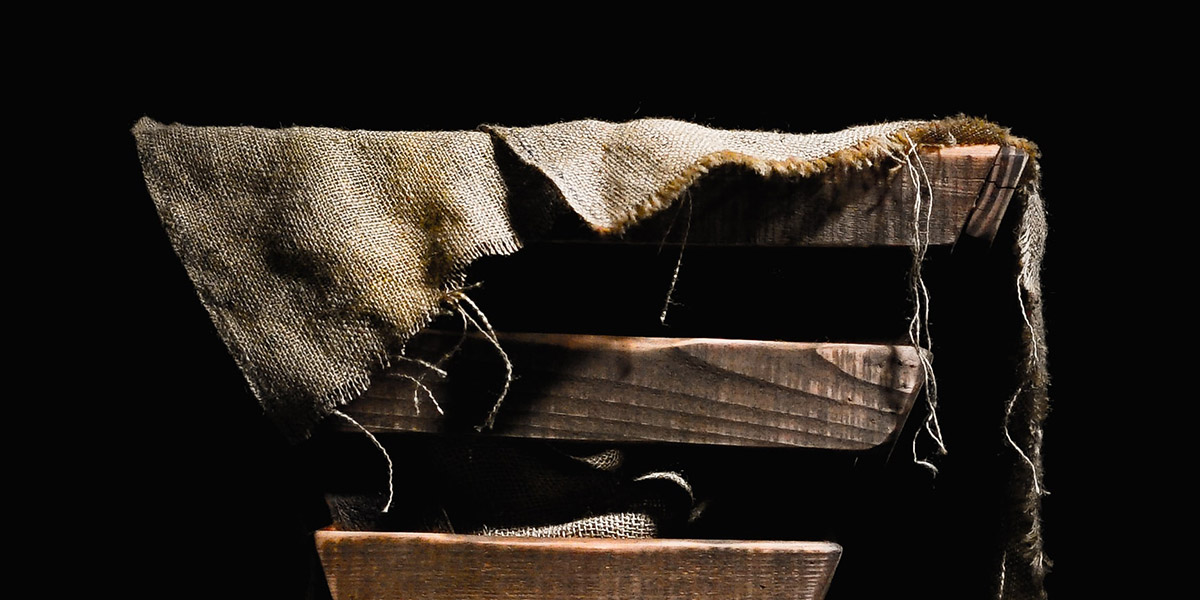
And there were shepherds living out in the fields nearby, keeping watch over their flocks at night. An angel of the Lord appeared to them, and the glory of the Lord shone around them, and they were terrified. But the angel said to them, “Do not be afraid. I bring you good news that will cause great joy for all the people. Today in the town of David a Savior has been born to you; he is the Messiah, the Lord. This will be a sign to you: You will find a baby wrapped in cloths and lying in a manger.”
Suddenly a great company of the heavenly host appeared with the angel, praising God and saying,
“Glory to God in the highest heaven,
and on earth peace to those on whom his favor rests.”
7. The Shepherds Visit the Manger
Luke 2:15-18
When the angels had left them and gone into heaven, the shepherds said to one another, “Let’s go to Bethlehem and see this thing that has happened, which the Lord has told us about.”
So they hurried off and found Mary and Joseph, and the baby, who was lying in the manger. When they had seen him, they spread the word concerning what had been told them about this child, and all who heard it were amazed at what the shepherds said to them.
8. The Wise Men Travel to Jerusalem
Matthew 2:1-8
After Jesus was born in Bethlehem in Judea, during the time of King Herod, Magi from the east came to Jerusalem and asked, “Where is the one who has been born king of the Jews? We saw his star when it rose and have come to worship him.”
When King Herod heard this he was disturbed, and all Jerusalem with him. When he had called together all the people’s chief priests and teachers of the law, he asked them where the Messiah was to be born. “In Bethlehem in Judea,” they replied, “for this is what the prophet has written:
“ ‘But you, Bethlehem, in the land of Judah,
are by no means least among the rulers of Judah;
for out of you will come a ruler
who will shepherd my people Israel.’
Then Herod called the Magi secretly and found out from them the exact time the star had appeared. He sent them to Bethlehem and said, “Go and search carefully for the child. As soon as you find him, report to me, so that I too may go and worship him.”
9. The Wise Men Worship the Christ Child
Matthew 2:9-12

After they had heard the king, they went on their way, and the star they had seen when it rose went ahead of them until it stopped over the place where the child was. When they saw the star, they were overjoyed. On coming to the house, they saw the child with his mother Mary, and they bowed down and worshiped him. Then they opened their treasures and presented him with gifts of gold, frankincense and myrrh. And having been warned in a dream not to go back to Herod, they returned to their country by another route.

10. The Trip to Egypt
Matthew 2:13-15
When they had gone, an angel of the Lord appeared to Joseph in a dream. “Get up,” he said, “take the child and his mother and escape to Egypt. Stay there until I tell you, for Herod is going to search for the child to kill him.”
So he got up, took the child and his mother during the night and left for Egypt, where he stayed until the death of Herod. And so was fulfilled what the Lord had said through the prophet: “Out of Egypt I called my son.”

Discuss the Story

After telling a story, allow your preschool child to talk about what she has heard. Ask her questions.

  • What is the name of Jesus’ mother?
  • Who is Jesus’ Father?
  • Where did God promise that the Savior King would be born?

Let her ask you questions. Talk about the characters in the story.

  • What do you think the angel looked like?
  • What kind of a person do you think Mary was?
  • How did the wise men look?

Talk about what God did and what the people did. Letting your child talk about the story helps her remember it and helps you perceive what she has understood and what needs further clarification.

For older children:

  • Ask questions concerning the response of individuals to the announcement of Jesus’ birth.
  • Compare them with the response of individuals today.
  • Include specific ways your family can be like the shepherds, the Magi, Mary and Joseph.

Sing Christmas Carols

Singing Christmas carols together is another effective way to teach and reinforce the truths of Christ’s birth. Using your church hymnal or a book of Christmas music, select pieces that reiterate the focus of each day’s section of the Christmas story.

Sing a different carol with each reading. After introducing several, allow your child to request and sing favorite ones with you. Talk about the words. Playing a recording of clearly sung pieces throughout Advent will help your child become familiar with and cherish the music of Christmas. 


Planning a time to sing carols in the neighborhood will help reinforce the story of Christmas and give the opportunity to tell the good news to your neighbors.

Joy to the World

by Slugs & Bugs | A Slugs & Bugs Christmas

Music courtesey of:

A Slugs & Bugs Christmas

Helpful Hints

Choose a Time

Designate more than one time to teach your child about the first Christmas. You cannot expect to sit down one night, tell your child of the birth of Christ, kiss him good night and assume you have accomplished your aim. Such significant truth demands repetition and clarification over days, weeks, months and years. Select a time, such as after meals or at bedtime. Begin early in December, and establish a meaningful plan for sharing the Christmas narrative.

Plan the Content

Plan to take a number of times to cover the entire Christmas story from beginning to end. Divide the story into small parts. The younger your child, the smaller the parts should be.

Tell the Story

Using the suggested divisions and Scripture references, tell the Christmas story to your preschool child. Hold your Bible, or his, as you speak. Use words he can understand. Watch his expressions. Be factual, but make the story come alive. Use dialogue and descriptions, but be brief. Allow your school-age child to read aloud the story from the Bible to you. If you have preschool and school-age children, your older child may enjoy telling the story to the younger child.

Include Biblical Truths

As you read and tell the story, incorporate the biblical truths that you want your child to begin to understand and believe. Insert a truth in the story line, in the midst of an action sequence or after a descriptive scene rather than by lecturing before or after the story.

Read Aloud from Scripture

In addition to telling the Christmas story to your preschool child, it is extremely significant and appropriate to read portions of it to him from the Bible. Many parents who read Luke 2:1-20 daily throughout the Advent seasonare delighted to discover their children — young and old — have memorized the Scripture just by hearing it read.

Memorize Verses

As you talk about the true meaning of Christmas, introduce your child to the promise God made in Isaiah 9:6 and the record of the fulfillment of that promise in Luke 2:11. Whether you are able to read Scripture aloud together as a family or not, make every attempt to help your child memorize these two verses of Scripture — Isaiah 9:6 and Luke 2:11.

Repeat the Story

As with any good and favorite story, your child is likely to ask you to “tell it again.” Be ready to repeat this wonderful story. Take your time in the telling and retelling of each portion. Repetition is a tool for learning. Encourage your children of all ages to tell it to you or to tell parts of it to you. Let the beauty of the gift of Christmas be seen in the attitude you hold toward even the telling of the story.

Use Bible Story Books

Sometimes parents are reluctant to tell a story to their child because they feel self-conscious or unskilled as storytellers. Do not let this keep you from teaching your child about Christmas. There are many fine story Bibles with factual presentations of the birth of our Lord Jesus Christ you can use. Read through the story prior to reading it to your child. If the truths you want to teach are not included, ask God to show you how and where to insert them. Pencil in the extra thoughts you plan to read. Begin with, “This is a story from the Bible,” then eagerly and enthusiastically read the story to your child.

Ask God to reveal the best way for you to begin this year to teach the truths of Christmas to your child. Telling (or reading) the Christmas story during the Advent season can become a tradition your children will anticipate and treasure as the years pass. Perhaps your entire family will be able to recite it together on Christmas morning as a gift to the Savior! 

Belief Beyond All Boundaries

Belief Beyond All Boundaries

Belief Beyond All Boundaries

BY BENNETT ROLAN, BSF DIGITAL EDITOR

Faisal doesn’t take a single BSF meeting for granted. For decades, Faisal and his family lived in a country where churches are scarce, prayer is hidden and Bibles are rare. Though they’ve been gone for several years, Faisal is grateful for every opportunity to study God’s Word openly.    

“I can’t imagine how I managed it, but there was a purpose behind all of those years,” he shared. “I don’t see it as a loss of years, I see it as a gain.” 

Faisal’s faith runs deep and he often shared the gospel, risking opposition for himself and his family. His co-workers even called him “the priest” because he steered everyday conversations toward biblical truth. 

But Faisal wasn’t always committed to Christ. Without access to a Bible or a pastor to guide him, Faisal’s focus on financial success distracted him from questions about faith. His family’s background compelled him to value nationalism over religion, causing him to resent the idea of a Jewish Savior. 

But God had plans for Faisal and his family. Just as He met Abram in the wilderness in Genesis 15, God undeniably called Faisal to Himself.

“There was some sort of a call, a voice, that said, ‘Faisal, you must go to church tomorrow.’ I don’t know if it was an audible voice, but it was clear to me. It was very strange. I just knew I had to obey, I couldn’t deny it. I told my wife, and she was very surprised. I just knew we couldn’t be late, as if I had a meeting with someone,” he said. 

“The sermon was from 2 Kings, and I liked the story. It was the first time I had heard anything from the Old Testament. Toward the end, the pastor explained that sin had poisoned the whole world and through the blood of Jesus Christ there will be no more sin. Something I had never heard before crept into my mind. What is sin? Why would I need Jesus when I’m not a sinner?”

Following The Call

During the months that followed, the gospel consumed Faisal’s thoughts. 

“It turned my whole life upside down,” he shared. “Somehow, I became miserable. It was a terrifying year actually. It was like a fight I had never encountered in my whole life. I was struggling with what I heard about Jesus, about sin, starting to ask myself, ‘Am I really a sinner? Do I need this Jesus the pastor was talking about?’ I kept hearing those words, that I am a sinner and only Jesus can purify me from that sin.” 

Faisal remembers “acting like a madman,” trying to understand the gospel in a country where Christians don’t openly profess their faith.

It was like my own Armageddon with God. I kept praying, ‘Leave me alone. I don’t want this happening in my life.’ Then, at the end of about a year and a half, I had another encounter with God. I saw the whole story of my life and it became obvious that the sinner the pastor was talking about was me. I always thought success would cover those things. Without actually knowing who He was, I knelt down and asked for grace. I didn’t own a Bible. It was a direct encounter between God and me.” 

I saw the whole story of my life and it became obvious that the sinner the pastor was talking about was me.

As God said to Abram in Genesis 15:1, “I am your shield, your very great reward,” He faithfully revealed His character to Faisal. In the most unlikely of circumstances, the God of Abraham, Isaac, Jacob and Jesus drew Faisal out of the “wilderness” and into eternal hope.

Forsaking All Fear

When Faisal confided in his wife, she was shocked by her husband’s transformation. After years of meeting with Christians in the area, she felt alone in her faith. But the man who had wrestled with God for more than a year came to her with a spirit of worship.   

The couple quickly became an integral part of a church network, often held in homes throughout the area. With limited Christian resources, Faisal and his wife quietly acquired Bibles and commentaries when they visited other countries.

“The Word of God was scarce, but I became deeply attached to it. The Word changed my life. I love the Word and the God of the Word.”

Meeting privately, Faisal’s small community of Christians drew close, bound by the grace that breaks all barriers.

“The only person who was present in our meetings was Jesus Christ,” Faisal shared. “We weren’t distracted by denominational differences or ‘what you believe, and I don’t believe.’ It was one of the most beautiful things.”  

“We met three or four times a week, praying for God’s protection. The hardest choice our Father made, sending His Son to die for sinners, never left my mind. Remembering what Jesus endured on the Cross for me was worth any risk.”

The word of God was scarce, but I became deeply attached to it. The Word changed my life …

Firm In Faith

For Faisal, the faith God forged years ago still compels him to share the gospel at every opportunity. And when he was asked to help start a BSF group, the answer was easy. Looking for a meaningful way to serve the Lord, BSF provided a much-needed opportunity for Faisal to support his brothers in Christ. 

“It’s completely different from a normal church or Bible study, where you sit down on a bench and listen to a pastor telling you what a passage is about,” Faisal said. “You get to dig to find value in the Word, you can talk and discuss and there is always something of value that you weren’t expecting.” 

During this year’s Beginnings study, Faisal feels a deep connection to Abram in Genesis 15:6, who “believed the Lord, and He credited it to him as righteousness.” Just as God commanded Abram to remember, “I am the Lord, who brought you out of Ur of the Chaldeans to give you this land to take possession of it” in verse 7, Faisal holds fast to the One who delivered him from sin into the land of eternal salvation. 

“When you look at the world through God’s eyes, you feel obliged to tell everyone about His love and grace, what He has done for sinners like us,” Faisal shared. “We don’t always know God’s purpose, but if we listen and obey, we can trust that there is good in all things. God is all over the place, he will never leave a person. Even in a closed country, there are no boundaries for Him.”  

Editor’s note: For the safety and security of Faisal and his family, names and other details were changed or omitted. 


Leadership Lessons From Abram

Leadership Lessons From Abram

Leadership Lessons from Abram

Looking at Crisis from God’s Point of View

By Chad Lackey – BSF Former Chief Administrative Officer

As I picked up the phone, I knew something was wrong. My wife was crying. The doctor had just pronounced our 2-year-old son profoundly deaf, a diagnosis that informed us of his inability to hear.  We had no perspective on how to process this diagnosis, just that the doctor said he would never effectively enter the hearing or deaf communities, and it was scary.

As a father, I did not want to admit it.  As a husband, I wanted to take away my wife’s fear and pain. As a man, I wanted to fix this! But in reality, I did not know what to do or how to proceed!

In Genesis 12, there is a story of a man, Abram, who was also dealt a serious blow. God called on Abram to move out of his city and into the promised land. He followed and God made some amazing promises to Abram – that his family would become many nations and bless the world! 

But as soon as he settled in the Negev, a severe famine hit the land and his people were all starving. I can imagine how badly he wanted to fix the situation. I think it’s clear he did not really know what to do next, either. 

As men, God has gifted us with the privilege of leadership in many areas of life, but nowhere more important than at home. When crisis hits, we default to problem-solving mode.  It goes like this: See the problem, see the solution, make a plan.

The question is, are you looking at the crisis from God’s point of view or your own? For me, there is often very little space between seeing the problem and solution and then making a plan. Abram’s story in chapter 12 gives us a painful example of what can happen when those decisions are based on my way and not God’s way.

Let’s learn from his story … 

Abram was a man of action. When faced with this crisis, he “solved” it. Let me be clear – there is nothing wrong with solving problems. But like so many men, Abram did not leave much room between seeing, solving and acting to solve these problems. He did not pause to consult God, and, as a result, the outcome was painful. 

Abram’s first choice involved preserving his people. He decided to take his people to where the food was in Egypt. We do not see that he paused to pray or consult God. He just saw the problem, saw a solution and made the decision to take his people to Egypt. 

Abram’s second choice involved self-preservation. Out of fear for his life, he instructed his wife Sarai to tell the Egyptians she was his sister. Again, we do not see him pause to consult God.  Instead, he saw a problem (or a potential problem), decided he could fix it and made it happen. Abram prospered for a time.

But God, wanting Abram to learn, let his plan spiral out of control. Sarai ended up in Pharaoh’s palace as his wife. The truth came out when the Lord brought sickness to Pharaoh and his people, so Abram and his family got kicked out of Egypt. 

When trying to understand why Abram did not consult God about these two decisions – especially given God’s unconditional promises to him earlier in the chapter – it brings me to a reality check.  Abram was a man who confronted his fears. In the face of that fear, he relied on himself — his plan, his fixes and ultimately his failure – instead of God.  

God lovingly wanted Abram to learn, so He allowed Abram to fail – even to the point that he was kicked out of the place he went for safety. (As a side note, we will see in the next chapter that Abram did not starve, and he ended up back at Bethel.)

Freedom in Surrender

God did, and still does, the same for me. Over the next several years, our family faced many difficult decisions. Who can help us know what to do next? How to communicate with our son? What school is best for him? Where should we live? How can we find a church with a deaf program? And many, many more.

Many times, I was like Abram – see, solve, fix with little or no time in between. Other times, we asked God for wisdom and guidance. Through it all, God taught us to rely deeply on Him. One significant learning came when we decided to move to a different school district with a great deaf program for Joshua. We bought a house before we sold the previous one because we were sure it was God’s provision.

After six months of depleted savings with double house payments, the day before I was supposed to start a second job, we sold the house!  The process of figuring out how to cover that decision was long, in-depth and painful. But I learned to rely deeply on God because He is the faithful Promise Keeper who loves me, my family and for sure my kids.

Every man is taught to be proactive and control his circumstances. The reality is, we control very little.  If you face difficult circumstances or decisions, I encourage you to ask God for wisdom, and He will give it (James 1:5). Let’s change “see, solve, fix” to “see, pray, obey!” 

This afternoon, I am going to play golf with my son, the same child who was never supposed to engage optimally with the deaf or the hearing! Today, he is a senior engineering student and plays on the college golf team, not to mention the only deaf student at his college!  

The 18 years since that phone call have been a roller-coaster of trying our own way and relying on God.  Looking back, I see how much we have come to rely on God and to trust His plan. I am thankful for His long-suffering patience with me as I have endeavored to lead my family well! 

Chad Lackey

Chief Administrative Officer


Testing Ourselves in Challenging Times

Testing Ourselves in Challenging Times

Testing Ourselves in Challenging Times

By Darrell Bock – Dallas Theological Seminary

No one doubts we are living in challenging times: massive cultural change at an exhausting pace, a world full of anger and an array of frustrations, all topped off by a pandemic leaving people to debate the best way to cope with its disruption. Conversations often devolve into arguments. Today’s U.S. election only heightens these divisions, and listening often gets cast aside. In this environment, the Great Commandment to love God and our neighbor often becomes an ethic left for another day and time.  

Just as troubling, if not more so, is how believers are treating one another as a result. It haunts me, as it might you, how people who have worshipped in joy next to one another for 20 or 30 years cannot talk rationally with one another because of issues in the public square.  

Such things ought not be. 

What are we defined by? 

I view our current climate in the U.S. as a litmus test of what really matters to us. Is it our shared faith, or something else? These issues are not isolated to one nation, race or gender, eitherIf we are not vigilant in our pursuit of Christ, we may all be tempted to elevate our own interests above God’s clear directives for His people. Through our Genesis study, we know that without God as the foundationeven our closest relationships can crumble.  

Just a moments pause and thought should lead us to see that in a fallen world things are often a mess. The ultimate fix is not in politics but in our faith and the realization that until Jesus returns, we will always be looking for a better day.   

Ephesians 6:10-20 tells us our battle is not against people (“flesh and blood”), but is a spiritual struggle against invisible forces with armor that is not determined by circumstances, politics or ideology. That armor is our livedout faithrighteousness, truth, the gospel, the Spirit, the Word and prayer. Our faith protects us frothe flaming arrows of the evil one. How we live it out relationally matters. The Great Commission remindus to share the good news of Jesus with others in gentleness, respect and speech that is always gracious (Colossians 4:5-61 Peter 3:15-16).  

Two more key texts direct me in this challenging time, and two observations put a check on my responses. 

Galatians 6:10 appears as the conclusion to Paul’s call to love your neighbor. This theme ties back to Jesus’ reminder in the parable of the good Samaritan that we are called to be good neighbors to every human being rather than selective about who our real neighbor is. This passage tells me to do good to all, especially those of the faith. Believers share a special bond! While God calls me to treat everyone well, I should go above and beyond for those who share my faith in Christ.  

1 John 4:7-14 reminds believers that our love for one another marks us as God’s children and should have priority over anything else. That bond is our shared realization that Jesus is the answer to our needs. The text is clear that love is rooted only in our relationship to Him and the love He gives to usAny other answer is less than Jesus. 

Here are a few checks I find helpful:

  Recognize that both policies and character matter deeply in our world, and we all make differing judgments about how to prioritize them when they are in conflict. One may lean one way or the other, and each may have good reasons for doing so. Respect and humility suggest we need to appreciate this reality. Be careful not to always elevate these issues to life and death or “good and evil” when all of us are making judgments about priorities, some of which are difficult calls.

 Run a series of self-examination tests. I can quickly tell if I am listening by whether I am forming a rebuttal while someone speaks to me. I am listening closely enough when I can repeat what they said in different words and they respond, You heard what I am saying. What kind of persons are we: rebutters or listeners? Listening and understanding is not necessarily agreeing. It is working carefully to appreciate the conversation, whether in agreement or difference. When we understand one another well, we can move a conversation along when it comes to substance. 

 Another self-examining question is: what really defines me, my faith or my politics? If it is my politics more than my faith, then perhaps the priority is in the wrong place when it comes to Christ’s call to love well. This does not mean we should avoid politics, but we can engage with Christ as our unifying center, while appreciating the challenging judgments we all make. 

Engaging with love

For many of us, current conflict is escalated by political controversy. Our culture divides everyday choices along political lines. We are asked to choose a side, leaving little room for a respectful discussion or even the opportunity to ask difficult questions, some of which have merit on both sides. This lack of respect is a sad development. Some controversial issues do force us to weigh decisions. When we weigh controversial issues in relation to loving one another and personal liberty, we can discern when and where a firm stand is required. Other times, a decision has to be made that does involve judgment.  

As an example of the latter category, BSF is asking class members, when they begin to regather, to wear masks because of potential health protections and benefits. The rationale for this decision is another kind of litmus test. When has Christian love said that what matters is my liberty and not care for my neighbor? Love is directed toward others, not self-focused. Regardless of some scientific debates, if my wearing a mask could save someone from a disease that can kill or damage another’s health, then my sacrifice is a form of love. It is being pro-life (as well as pro-love)! Our call is always to love well. This organizational decision reflects expressed care for my neighbor in our corporate context and gives testimony to our willingness to love. 

I pray members listen to the concerns of their brothers and sisters on both sides. In a culture that feeds off controversy, believers must weigh the cost and benefit of decisions while considering Christ’s call for love, action and unity, especially when the choice does not involve moral or theological compromise. 

No matter what the future holds, we are in challenging times. But believers have the Spirit of God to overcome whatever goes on in the world. “The one who is in you is greater than the one who is in the world (1 John 4:4). We do not live in fear, but we live confidently in the power (enablement), love and selfcontrol that comes only from our faith (2 Timothy 1:7). If we examine ourselves with these perspectives, maybe we can check ourselves and engage in fellowship rooted in the main thing. Perhaps by remembering the most important thing that unites us, we will grow together as we engage one another in love, even with our differences.  

Dr. Darrell Bock

Dallas Theological Seminary

Dr. Darrell Bock is senior research professor of New Testament and executive director for cultural engagement at Dallas Theological Seminary. He hosts The Table Podcast, leading discussions related to God, Christianity and culture.

Submit a Comment

Our BSF staff approves each comment to maintain privacy and security. It may take 24 – 48 hours for your comment to be posted. Be sure to check back for replies from the author or other BSF members!

Where Is God When Your World Is Shattered?

Where Is God When Your World Is Shattered?

Where is God when your world is shattered?

By Bennett Rolan – BSF Editorial Manager

Catherine Barker can still picture 7-year-old Samuel’s “jaunty run. With arms outstretched, jacket flying and rain boots splashing through the field behind their South Wales homeSamuel’s “cheeky” grin radiates pure joy.  

But as quickly as Samuel is there, his image fades into a memoryJust nine months ago, Samuel was involved in a traffic accident outside their home. Samuel did not survive, and his mother’s grief is still raw.  

In the early days after her son’s death, Catherine found solace in the nearby field as a place to wrestle with her thoughts. 

I wasn’t feeling angry at God. I knew God was angry too. But I did feel a general sense of anger, a sense of ‘Why?’” Catherine said. “Why is he gone when I can see him so clearly in my mind’s eye? 

During one of those quiet walks, with her anguish exposed, Catherine realized she was not alone. 

“God spoke to me very plainly in that moment. He gave me the Bible verse when the women go to look for Jesus in the tomb, and He’s not there. The angel says, ‘Why are you looking for the living among the dead?’ It was as if God said to me, ‘Don’t conjure him among the fields. Why are you looking for him here?’  

It was God’s way of saying to me, ‘Don’t be sad that Samuel isn’t here anymore. He is better off where he is. He is alive!’ 

There have been so many times when God has put an unexpected verse or Psalm into my head. Only He can do that.”

Another surprising moment with the Lord came just hours after Samuel’s death. 

Words can’t describe how I was feeling that first night. But God put joy into my heart to the point that I was actually smiling eight hours after it happened. That’s not human. No amount of human willpower can do that, it was just from God. 

“What put that smile on my face is the assurance of where Samuel is. As a parent, you’re never happier than your saddest child. If your child is unwell, you hurt too. Samuel will never be my saddest child. To a grieving mother’s heart that is the best balm you can give. I do get really, really sad, and I miss him. But what I can also do is tell myself the fact that biblically he’s not lostHe’s with Jesus.”

For Catherine, her husband, Jim, and two other sons, Samuel’s death revealed the gravity of pain in fallen world. Now, more than ever, they cling to the assurance of God’s promise to restore all things.  

“This world is a shadow, a beautiful shadow, but a shadow nonetheless of what is to come. Life is very precious, but life is not all there is. No matter how much I used my head knowledge before, I couldn’t long for the hope of heaven. But my experience of suffering has widened the difference between this life and how brilliant heaven is going to be – no death, no grieving, not distracted by our own sinful desires. We will be dressed in clothes of righteousness standing in the holy presence of God.”  

Though her grief runs deep, Catherine’s joy and hope run deeper. Through the loss of her precious son, Catherine’s relationship with Christ is her lifeline to wake up in the morning, snuggle with her sons, laugh with her husband and comfort Samuel’s friends.

Prepared by His Promises

Pointing to distinct moments before Samuel’s death, Catherine fully believes God prepared her to shoulder the sadness and glorify Him in her pain. 

Through years of in-depth study as a BSF children’s leader, God equipped Catherine through His Word. He planted His promises in her heart and built a faith to weather the storm.  

Studying Genesis several years ago taught her obedience and reading through the Gospel of John deepened her conviction of God’s love. In 2019, while studying 1 Samuel 1, Catherine’s Teaching Leader posed a difficult question. 

She asked, ‘Are you willing to give God the thing that’s most precious to you?’ and of course, my children immediately came to mind,” Catherine said. I was thinking, ‘Can I really offer my children to God?’ 

“At the time I couldn’t, and it really bothered me. Weeks later, clearly remember going through my routine of praying in the boys’ rooms after they went to bed. I was in my older son’s room, kneeling to pray, and I was finally able to let go of my children and give them back to God. I had my hands up. I said, ‘Take them Lord, they’re Yours.’ In my heart, I accepted that God could look after them better than I ever would. I knew that to surrender them to Him would be the best thing I could do for them. 

God used that moment to strengthen Catherine’s dependence on Him, and after Samuel’s deathCatherine held onto His unshakable promise in Genesis 8:22While the earth remains, seedtime and harvest, cold and heat, summer and winter, day and night, shall not cease.” 

“God promised springtime and harvest for generations to come. Every time we get a load of acorns on the oak tree, I know I can cling to the Maker of heaven and earth,” Catherine said. “Sometimes at night I go out to look at the silhouette of a tree against the night sky and see the stars. It’s so comforting to know He made those stars and we’re not out of His control. My experience isn’t outside of His experience. He’s got this, and he’s also got Samuel. 

Faith in His Future

As we study God’s words to Noah in Genesis 89, we reflect on the familiar sign of the rainbow, signaling that God keeps His promises in spite of our sin. 

Noah’s sacrifice in Genesis 8:20 and God’s controlled wrath in Genesis 9 remind us of a later covenant, forged by the blood of the ultimate sacrifice. Instead of an altar, we can cling to a cross and instead of a rainbow we look to an empty tomb. In His covenant with Noah, God promised restraint. But in His covenant through Christ, we are promised redemption. 

And with that assurance, Catherine can rest in the mercy of her Heavenly Father. 

“I knew I could trust Him. If He sent His son to die for me, I could trust Him with mine,” she said. “When God took Samuel, He had already prepared my heart. He waited until I was ready to trust.” 

Though Catherine’s grief cannot be undone on this earth, she clings to the promise of eternity.

For each of us, suffering is real and loss is inevitable. Like Noah, waiting for God to open the door of the ark, we may feel the storms of life tossing us in every direction. But the words of Genesis 8:1 give us insight into God’s character: 

“But God remembered Noah …”

As His people, we too have confidence that God remembers us. 

For those who feel like they’re stuck in the boat, I would encourage them to remember who God is,” Catherine said. Remember how He has already shown His faithfulness to you or others you know. Read stories from the Bible that remind you of God’s faithfulness. Very often, God gives us work to do while we wait for Him. Trust the Lord and His timing, He won’t forget you. The rainbow in the sky is a message from God to all creation that says, ‘I’ve not forgotten you. I remember you.

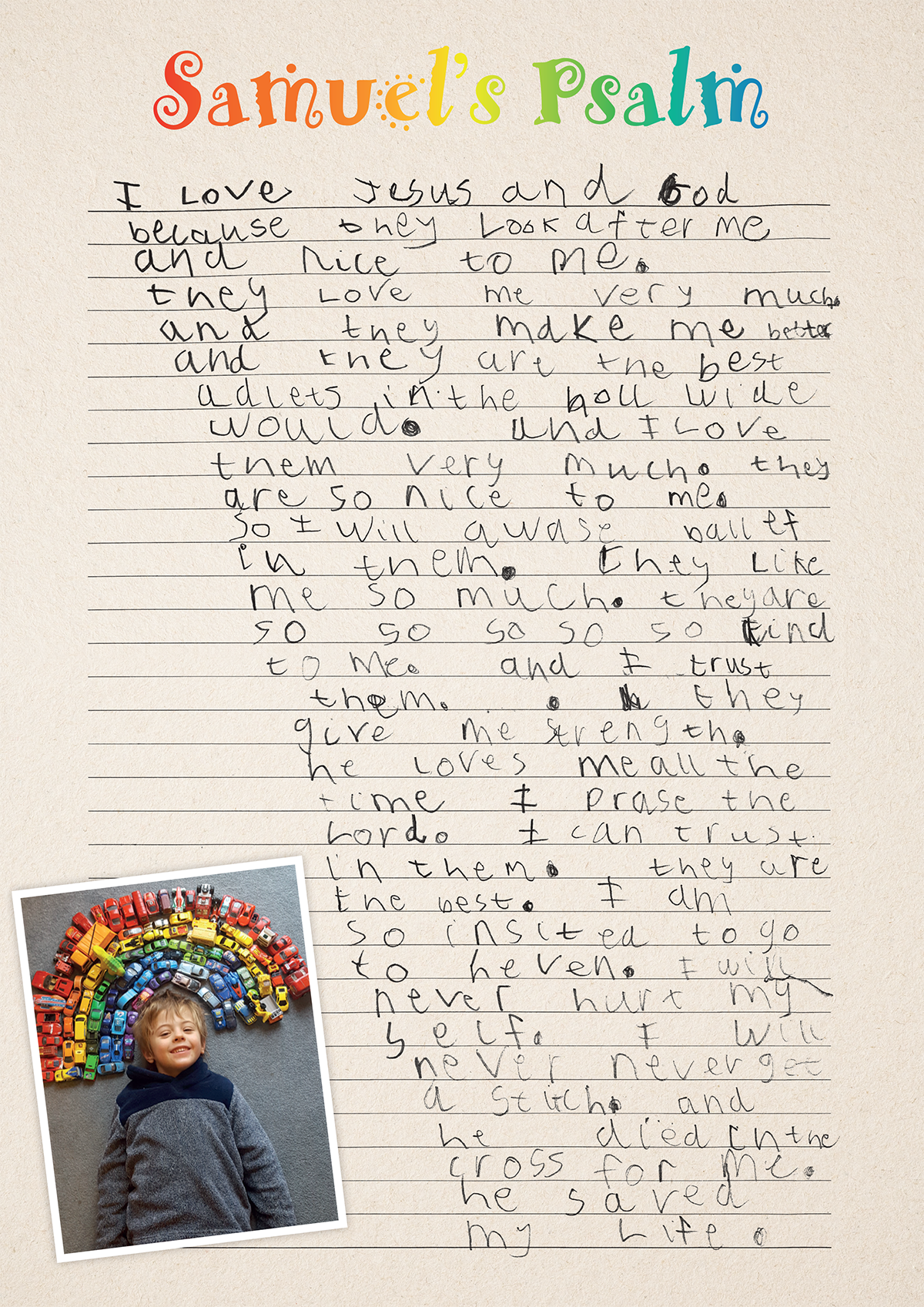
Having attended BSF from his infancy, Samuel was grounded in God’s Word. At the age of 6, Samuel wrote a Psalm. In squiggly pencil handwriting, he captured the purity of God’s love for His people. After his death, Samuel’s Psalm circulated through the Barker’s local community, international friend group and beyond. As we thank God for Samuel’s life, we must also thank Him for Samuel’s faith.

“I used to pray for Samuel, that he would be a great man of God,” said Catherine. That God would bless him early with a true faith that would stand the test of time. He was never the great man of God I expected, he didn’t become a minister or anything like that. But what he’s done has touched more people than we could ever have imagined. I’m grateful for that.”  

Bennett Rolan

Editorial Manager

Bennett Rolan joined the BSF staff in 2017 after working for several Christian ministries and non-profits. She loves to combine her passion for God’s Word and her journalism background to share stories of God’s Work in and through BSF. As a wife to a busy college football coach and a mom to four young children, BSF studies keep her relationship with the Lord grounded and focused. She loves to learn from fellow believers as God faithfully grows her each day.


Submit a Comment

Our BSF staff approves each comment to maintain privacy and security. It may take 24 – 48 hours for your comment to be posted. Be sure to check back for replies from the author or other BSF members!

Addressing Hard Topics with Children

Addressing Hard Topics with Children

Addressing Hard Topics with Children

God Welcomes Your Child’s Questions 

By Dana Wilkerson – Former BSF Curriculum Development Director

Children are certainly unpredictable. When they say something extremely funny, we know what to do – either laugh or try to hide your laughter. But what can we do when they ask questions about a difficult topic? Do you know what to say? If not, don’t worry. You are definitely not alone.

Words are powerful. The way we respond to children and their questions has an effect on how they grow in their faith. But don’t let that scare you, because there is Someone who can help. Rely on the Holy Spirit as your guide. You can trust God with your child and with their questions. The goal is not to provide all the answers. The goal is not even to find all of the answers. The goals are for your child to know Jesus better and to learn they can trust God with their questions – both big and small.

You can trust God with your child and with their questions.

During this year’s study of Genesis, your child will most likely ask some of those hard questions. Rest assured that the BSF materials do not go into detail on these issues with your younger children. But they may still ask you some questions after their BSF lessons.

These are some of the topics that appear in Genesis:

  • Lesson 7: Racial injustice and drunkenness

  • Lesson 12: Homosexuality and rape

  • Lesson 13: Abandonment and divorce

  • Lesson 22: Rape and slaughter

  • Lesson 23: Sex and prostitution

  • Lesson 24: Infidelity

This might feel overwhelming, but we have created a framework that can help you engage in a conversation no matter the topic at hand:

Acknowledge your child’s questions or concerns

1. Validate their comments or questions.

2. Normalize asking questions.

3. Acknowledge their thinking.

You can say:

“I’m glad you asked that question. We all have questions. Let’s talk about this.”

“I’m impressed by the way you think about this.”

Allow your child to explore the topic

1. Clarify or define words or context.

2. Discover how the topic makes your child feel about themselves, people, or God.

3. Open up respectful discussion of viewpoints.

You can say:

“Do you know what this word means?”

“How does this make you feel about God?”

“What do you believe about this topic? How do your beliefs affect you?”

Admit we all need God’s help

1. Admit you and your child must humbly depend on God together for answers and understanding.

2. Acknowledge you are still learning.

You can say:

“It is hard to understand how things like this happen. We both need God’s help to see clearly.”

“It feels uncomfortable when people believe different things.”

Affirm a truth about God and/or people

1. Give your child a biblical truth to hold onto as they wrestle with the topic.

2. Connect the discussion to one of God’s attributes.

You can say:

“God’s image in us gives every person worth and purpose. How does that truth encourage you?”

“God is incomprehensible, but He loves it when people seek Him! What do you think about asking God to help you understand Him better?”

Avoid common pitfalls

1. Prevent the possibility of your child feeling shame for asking a question.

2. Do not respond from shock.

3. Avoid potentially shutting your child down from asking future questions.

4. Do not make assumptions about what they know or believe.

5. Do not try to force them to believe something.

6. Based on your child’s age and stage of development, do not give more information than they need or than they ask for.

Try to avoid saying:

“That is not an appropriate question.”

“You are too young for this topic.”

“How could you doubt that about God?”

“In our family, this is what you must believe.”

We pray this framework helps you guide your children to God for the answers to life’s toughest questions. Thankfully, He is big enough to bring clarity to our confusion. We can rely on His Spirit will provide wisdom and comfort as we walk alongside our children in their spiritual growth.

Pin It on Pinterest