
Jesus’ Ultimate Lifestyle Guide

Jesus’ Ultimate Lifestyle Guide

Jesus’ Guide to the Ultimate Lifestyle

By Dr. Mark Bailey- Dallas Theological Seminary

How do ordinary people, living ordinary lives, live “in the world, but not of it?” 

Every morning we wake up and go to work. Most of us watch the news and check our email. We care for our families and enjoy our friends. On the surface, we look a lot like our neighbors. But as Christians, God calls us to be different. That difference is for a distinct purpose. Jesus tells us in Matthew 5:16, to “let your light shine before others, that they may see your good deeds and glorify your Father in heaven.”   

As Christ followers, Jesus asks us to pursue a life that’s fundamentally different from the cultures around us, even in the everyday moments. 

In 1 Thessalonians 4:11-12, Paul tells us to “make it your ambition to lead a quiet life: You should mind your own business and work with your hands, just as we told you, so that your daily life may win the respect of outsiders …” 

In His Sermon on the Mount, Jesus casts a vision for a fulfilled life that surpasses all others, the ultimate lifestyle. A life that is fundamentally different from those around us. And, who would not want a secure future, to leave a lasting legacy, to enjoy great relationships and possess unusual insight?

Through the Beatitudes, Jesus promises these things and more to those with a mindset to pursue Godly character. But along with the blessings come distinct conditions. Jesus proposes these unique qualities to us in the Beatitudes in Matthew 5:1-12.

A Secure Future

“Blessed are the poor in spirit, for theirs is the kingdom of heaven.”  

If we want a secure future that extends through this life and into eternity, we need to come to Jesus with a humble heart of faith. This humble approach recognizes our spiritual poverty, which can only be addressed by God’s gracious provision. The assurance of our present possession and future presence in the kingdom of God is only possible by recognizing our spiritual need is total and not partial. Faith is a response to grace that only God can provide.  

A Calm Heart

“Blessed are those who mourn, for they shall be comforted.”  

If we want to maintain a calm heart and a cleansed conscience in a fallen world, a conscious recognition of sin followed by appropriate repentance is a necessity. Mourning in the Bible is almost always associated with the conviction of the sin. Comfort comes with the promise that God is faithful and just to forgive when that sin is confessed (1 John 1:9).

A Lasting Legacy

“Blessed are the meek, for they shall inherit the earth.” 

If we want to experience all that God intends us to experience in this world, we need to bring an attitude of gentle restraint, and place whatever power or authority we possess under His control. Meekness is not weakness, but a tender heartedness knowing that the reward for servant-hearted leadership will be rewarded in the future when we co-reign with Christ in His kingdom.

A Deep Sense of Fulfillment

“Blessed are those who hunger and thirst for righteousness, for they shall be satisfied

If we want to live a fulfilling life of meaning and purpose, we must come with a teachable spirit to learn God’s definition of what a flourishing life should look like. A biblical worldview means living life “rightly” according to the revealed standards of God. 

Great Relationships

“Blessed are the merciful, for they shall receive mercy.” 

If we want to enjoy meaningful relationships with other people, we need to reflect the gracious love and forgiveness we have received from God toward others. Corrie ten Boon, survivor of Nazi imprisonment in World War II, said, “To forgive is to set a prisoner free, and then to discover the prisoner was you.” As we see in the Lord’s Prayer, Jesus taught us to ask for forgiveness while we also extend forgiveness to others.

Unusual Insight

“Blessed are the pure in heart, for they shall see God.”  

If we want to gain unusual spiritual insight into the ways and wisdom of God, we will need to live a life of holiness by allowing God to cleanse us from all unrighteousness. Like Moses, we should sincerely pray to the Lord: “Show me now your ways that I may know you in order to find favor in your sight” (Exodus 33:13).

A Great Reputation

“Blessed are the peacemakers, for they shall be called sons of God.” 

If we want to earn a Christ-like reputation before a watching world, we must be known for promoting reconciliation with a spirit of fairness, free from partiality. According to this text, we are most like Christ when we seek to bring people back into harmonious relationships. In fact, Paul summarized the ministry to which he has called all believers as ambassadors for Christ with a single term: “reconciliation” (2 Corinthians 5:18).

Rest in Future Justice

“Blessed are those who are persecuted for righteousness’ sake, for theirs is the kingdom of heaven. Blessed are you when others revile you and persecute you and utter all kinds of evil against you falsely on my account. Rejoice and be glad, for your reward is great in heaven, for so they persecuted the prophets who were before you.”  

If we want to faithfully endure hardship, misunderstanding, or slander for the sake of the gospel with the hope of ultimate justice, we will need to come to Jesus with an attitude of patient rejoicing. When we know our heavenly reward is coming, we are in good company in whatever we face. Peter prompts us to remember others suffering around the world by resisting Satan while at the same time standing for the faith (1 Peter 5:9). 

Jesus follows the Beatitudes in Matthew 5:13-14 by teaching, “You are the salt of the earth. But if the salt loses its saltiness, how can it be made salty again? … You are the light of the world. A town built on a hill cannot be hidden.” Jesus tells us that people of such integrity make an impact for Him in the world. The beatitudes and their prerequisite behaviors are what make God’s people the “salt and light” that counter the decay and darkness of this present world.

In the Sermon on the Mount, Jesus tells us how to establish a credible witness to our neighbors. He tells us how to be different and find fulfillment in Him. Let us not be a people who lose their saltiness. According to Jesus, living with the values of God’s kingdom, while awaiting its consummation, is the ultimate lifestyle.

Dr. Mark L. Bailey

BSF Board Member

Dr. Mark L. Bailey is the Chancellor and Senior Professor of Bible exposition at Dallas Theological Seminary in Dallas, Texas, He has served at DTS for 37 years. Prior to assuming the seminary’s presidency, Dr. Bailey served as professor of Bible Exposition and vice president of academic affairs. He pastored churches in Arizona and Texas. He was seminar instructor for the Walk Thru the Bible Ministries for 20 years and is in currently in demand for Bible conferences and other preaching engagements. He is married to his wife, Barby, and they have two married sons and six grandchildren.


 

Submit a Comment

Our BSF staff approves each comment to maintain privacy and security. It may take 24 – 48 hours for your comment to be posted. Be sure to check back for replies from the author or other BSF members!

Responding to the Wilderness

Responding to the Wilderness

Responding to the Wilderness

By Nate Thoreson – Regional Director

I strained to hear any sounds through the phone. Nothing. I told my son I loved him, but he didn’t respond. He was 3,000 miles away in the Critical Care Unit, and my wife was on a flight to be with him. The stark reality weighed heavily on me as I thought, “My son may die today, and there is truly nothing I can do to stop it.”  

I wept.    

While attending college in Massachusetts, our 20-year-old son contracted double pneumonia. His lungs mysteriously filled with unstoppable fluid. Waiting for news across the country, I prayed, “Lord, I know that you are the only One who is sovereign, and I know that you can choose to let my son live or choose to take him. If you do, I want you to know that I will still follow you.”  

 Everything in me was being tested at that moment. I felt completely alone. But remembering God’s Word prepared me to face the fear of the present. I didn’t understand God’s plan, but I knew I could trust Him. I realized my faith was real, and my God was, too.  

Into the Wilderness

Matthew 4 begins with Jesus in the wilderness. As a man, He had been pushed to His very physical limits. Completely alone, Jesus was tempted by the father of lies. In this gripping passage, Jesus not only withstood temptation but used God’s Words to do so.  

Hebrews 4:15 reminds us Jesus “has been tempted in every way, just as we are – yet he did not sin.”  

In my own personal wilderness, waiting for news about my son, I was tempted to fear, worry, anger, doubt and so much more. But remembering Jesus’ response in the wilderness helped me to see beyond my “desert.” Focusing on His Word, His promises, and His character gave me the strength to stand firm in my faith.  

Years before my son was even born, I approached God’s Word as good advice, a way to do good things and avoid bad behavior. But my attempts to earn God’s favor only left me exhausted and joyless. Slowly, God revealed to me the truth: Scripture is not offering good advice, but good news!  

I didn’t need good advice while waiting to hear about my son’s fate. I desperately needed good news. And the truth that Jesus felt what I felt, walked where I walked, and gave His life for mine was more than enough. The ultimate power of His resurrection and ascension secured my hope in His eternal promise and gave me a foundation to stand on when trials came.  

That day, God spared the life of my son and strengthened my family’s faith. We were transformed in the wilderness. When we emerged on the other side, we wondered, “What now?”

Sharing the News

After His testing in the wilderness, Jesus did not go back to His normal life. He went to Capernaum, and in verse 16 we are told He fulfilled the prophecy “the people living in darkness have seen a great light; on those living in the land of the shadow of death a light has dawned.” 

Jesus began to preach to many, and He called a few. Walking beside the Sea of Galilee, in verse 19, Jesus simply said, “Come, follow me, I will send you out to fish for people.”  

For those of us who have experienced Christ, who have seen the light in the wilderness, we are compelled to share that good news  

When Jesus called Simon and Andrew, He offered them more than good advice. He offered them a path to follow, a purpose to pursue and the power to change. Jesus asked them to come, promising He would do the transforming and the sending.  

So where is God sending you? Take a moment to remember your own days in the wilderness. Think about Jesus’ comfort, presence, and power. How will you respond?  

Matthew 4 gives us the framework. Following Jesus’ example, we can simply share and invite. Perhaps God is also calling you to share with a co-worker, a friend, or a family member from your own wilderness experience to offer them some Truth, hope, or peace.  

Today, I see the fruit of God’s Matthew 4 promise in my own life. Our son, who nearly died, is alive and following Christ. As a newly trained pastor, he and his wife are responding to God’s direction to “fish for men.” The seeds God planted through His Word have grown in ways we never imagined. 

A simple way to start is by inviting someone to experience BSF. What would it look like if every person in your group invited someone to join? How would our communities change? How might God transform our families through His Word?  

We may not have good advice to offer in every situation, but that’s okay because we have something better. We have the Good News of the gospel, and that lasts for eternity.  

Nate Thoreson

BSF Regional Director

Nate is the Director of Men’s and Regional Directors at Bible Study Fellowship Headquarters. A physical therapist by training, he and his wife, Barb, moved from Idaho to Texas to answer God’s call to BSF Headquarters. Their son and daughter-in-law, Luke and Sierra, and baby Amira live in Boston. His daughters, Kiana and Sara, are dancers in college. Nate has been a Children’s Leader, Substitute Teaching Leader, and Teaching Leader. He loves Jesus and likes adventures, good coffee, and chocolate chip cookie dough!  


A Place to Belong

A Place to Belong

A Place to Belong

By Hollie Roberts – BSF Executive Director

I was just another face in the crowd, one of 150 women gathered to study God’s Word in a BSF class. 

Nothing about me said “BSFer for life.” I was six weeks away from having our first child, and I walked into that group with a temporary mindset. “I’ll give it six weeks. This may not be for me.”  

But through God’s grace, my Group Leader saw beyond the shy woman before her. She saw me. In fact, she saw and sought to know every woman in our group. Her goal was not to win us to BSF. Her desire was that God would plant a deep love for His Word in each one of us through study and real community.

Six weeks turned into eight. Eight weeks turned into a year. And one year has stretched into many as I write to you from BSF Headquarters.  

This is my BSF story. God has faithfully used these studies to shape and grow my faith through times of real struggle and true victory. 

But my story is only one of many. This year alone, BSF will have 400,000 unique stories to share as members gather around the world to study Matthew.

In such a great crowd, will one story make a difference?  

Unique Stories

Matthew 1 begins with a genealogy. The author could have opened with a mighty miracle or listed the many prophecies Jesus miraculously fulfilled. Instead, Matthew begins with a list of names.  

Some names are familiar, such as Ruth and David, but who is “Eliud the father of Eleazar” or “Azor the father of Zadok”?  

These are easy verses to want to skip. But like every word of Scripture, God included this list for a reason. He knit together each story as part of His grand narrative – His salvation plan for humanity through His Son.  

Every name on this list is a person who matters to God. Psalm 139 tells us God created their inmost being. He knit them together in their mothers’ wombs. He knew their fears, their worries, their sins, and their hopes. He walked beside them as they led thousands and comforted them in great loss.  

God intimately knew every man and woman included in Matthew 1. And God knows you completely. There may not be a book in the Bible called “Azor,” or even a passage about his life, but his value before the Creator of the universe is absolute.  

So often, we want to become an Abraham or a David. We long to measure our faith by the actions of Ruth and Rahab. But David did not become “a man after God’s own heart” in a day. And God spent years preparing Abraham for the moment that his belief was “credited to him as righteousness.” God built these men and women of faith over a lifetime. He met them in the small, everyday moments, preparing them for the times their faith would be tested. 

We may not know anything about Azor’s life, but God does. And if God used Azor to weave the bloodline of Christ, how might He be using you? 

Woven together

Genealogies throughout Scripture remind us that God links us together, from one generation to the next. Matthew 1 is a collection of wealthy and powerful leaders divinely linked to outcasts and exiles. Together, this group leads to the birth of the greatest Leader and Outcast the world has ever known: Jesus Christ, our Unexpected King. 

The genealogical path to the Messiah was crooked and messy. But that was God’s perfect plan. 

In these names we see that God is sovereign over all things. No wealth, power, influence, or affluence was greater than God’s plan. And no tears, pain, struggles, or hardship escape His notice.  

Nothing we do has the authority to shift God’s purposes or plans. But through His kindness and grace, we are invited to participate in His story. 

So how will your story make an impact this year? And whom will God use to help you write it? 

Just as every person listed in Matthew 1 matters to God, so does every person in your BSF group. He knows the woman on your Zoom screen and the man sitting next to you as you learn from one another. Will you take time to know them, too?

Without a Group Leader who was willing to get to know me years ago, I would not be writing this blog today. I pray that each of us, whether the world sees us as Abrahams or Azors, would see one another as God does. Through His Spirit and the power of His Word, we are all connected as part of God’s wonderful redemption story. 

May we remember Matthew 1 as we meet each person who comes to our groups. May we invite those whom God places in our paths. May our group list read like the genealogies in Scripture. There is room for anyone and everyone who wants to come. 

Hollie Roberts

BSF Executive Director

Hollie joined the BSF Headquarters Staff in 2018. She served as a Regional Director and Chief Field Development Officer before becoming the Executive Director. Hollie first attended BSF in Amarillo, Texas, where she began serving in leadership as a Children’s Leader (CL) and Group Leader (GL). After moving to Houston, Texas she continued to serve as a CL and GL, before becoming a Teaching Leader. Hollie and her husband Kevin have two sons, a daughter-in-law, and three grandchildren. Her family is actively involved in BSF.


Submit a Comment

Our BSF staff approves each comment to maintain privacy and security. It may take 24 – 48 hours for your comment to be posted. Be sure to check back for replies from the author or other BSF members!

Being Available to Christ

Being Available to Christ

Being Available to Christ

By Susie Rowan – Outgoing BSF Executive Director

When I was a young believer, a man handed me a small card at a church potluck (when we still had those). All it said was, “Ask simply to be used.”

The man was a mattress salesman. There was nothing special about his appearance or his pedigree. Yet his impact for the glory of God is still rippling years after his death. His funeral was attended by nearly a thousand people, and notable Christian leaders told stories about his love for God and influence on others. I carried that card with me in my wallet for years, and even after it was lost, the Spirit continued to bring that phrase to mind: “Ask simply to be used.”

Today, God is using that little card and its simple words once again. It translates to me as “Be available.” I pray, “Lord, I am available for your service today. How would you like to use me?” As I listen for God’s voice and watch how He orchestrates my day, He reminds me of the availability of Jesus. 

Christ is Available to Us

In this year’s Matthew study, we will behold the unexpected availability of Jesus. 

God sent His one and only Son to us. Jesus willingly left heaven to come for us. A virgin conceived and gave birth to a Son, whom we call Immanuel, “God with us.” The Almighty God of heaven and earth put on flesh to become available to us, to offer eternal salvation and a reconciled relationship with Him. 

And throughout Matthew’s Gospel, we will see Jesus’ availability to the needs of those who humbly sought Him. Jesus was available when the crowds needed food (Matthew 14:13-21). He was available when the people needed healing (Matthew 4:23-25). Most importantly, He sacrificed all to make forgiveness and redemption available to us. And now Jesus’ availability continues forever. For He did not leave us as orphans when He ascended into Heaven but rather increased His availability by sending His Spirit to dwell in His believers and walk with us through life. Just as He promised the disciples and us, “I am with you always, to the very end of the age” (Matthew 28:20).

In response, Simon Peter, Andrew, James, John, and many others left behind their fishing nets, boats and former lives to follow Jesus (Matthew 4:18-22) and live every day available to be His hands and feet in the world.

Are We Available to Christ?

This is a recurring theme throughout the Bible. Those who know and follow Christ make themselves available to Him. Isaiah recognized the risen Christ on the throne and said, “Here am I. Send me!” (Isaiah 6:8 and John 12:41). Ananias, in a vision, was told by Jesus to lay down his plans to restore a man named Saul, also called Paul, for ministry to the Gentiles (Acts 9:10-19). In both instances, Isaiah and Ananias made themselves available to Jesus for an unexpected and risky assignment.

Many of you have very full plates. You are swamped with responsibilities – demanding work hours, caring for aging parents, raising a houseful of children, providing for loved ones, and more. Daily, you sacrificially become available to your family, employer, ministry, and so much more. Yet there are still times when we will be called to adjust our plans to the unexpected needs of friends, co-workers, or unforeseen assignments from the Lord. Often this means putting aside our own convenience to get involved. Sometimes this means taking a risk. 

There are other seasons of life when heavy loads of responsibility are lifted. A new city, a lost job, a child getting married, a big hole in your schedule. 

Here I Am, Lord

Last month I enjoyed lunch with a friend and former BSF Teaching Leader. We talked about her adjustment to a life with little responsibility after a move. She left behind her former home and teaching role within a BSF class. And the Lord made it clear she was not to jump into anything new. It was a season of quiet and waiting. It was a lonely season. Yet it became a refreshing season that led to a new assignment from the Lord. 

Today, I find myself in a new season, transitioning from a place of weighty responsibility to a stage of real availability. As I now retire from BSF, there is a big hole in my daily life. My temptation is to rush to fill it. But the Lord has spoken these words to me, “Be available.” “Ask simply to be used.” And good friends have counseled me, “Don’t take on too much too soon.” Rather than filling the hole in my schedule, I sense the Lord wants me to be available to see what He is about to do with each new week ahead.  

Is there a family need?  

Does a friend need help?  

Is someone sick who needs food?  

Is there a new assignment? Will it involve risk, a change of plans, a new direction?  

For now, being available to God is enough. Jesus is with me. He has redeemed me. He has filled me with His Spirit. So, I will continue to serve Him with spiritual fervor and zeal to make disciples of all nations. Whatever it looks like, I will be available to my Savior. For a short time, I expect to serve Him in quiet, with a focus on family. I will serve Christ’s Church as a seminary board member and in my local church. And in time, I hope to explore some teaching, writing, and mentoring as the Lord gives opportunity. 

But – bottom line – whether our schedules are full, open, or anywhere in between, being available to God is our worshipful response to His constant availability to us. 

If we ask “Lord, how do you want to use me today?” we might find our Kingdom impact to be like an ordinary mattress salesman who asked, “simply to be used.”

Susie Rowan

BSF Executive Director

Under Susie’s leadership as executive director, BSF membership has grown to serve more than 385,000 adults and 66,000 children worldwide, and the ministry has introduced BSF Online and WordGo Bible study platforms, and four new studies – IsaiahRevelation, and People of the Promised Land I and II (Part II coming in 2022). Susie and her husband, Roger, have been married for 45 years and have two children, Jerry and Sally, and four grandchildren.


Submit a Comment

Please note that comments are monitored and approved by BSF staff. If you don’t see your comment immediately, please visit this page again to view your comment along with responses from the author and other BSF members.

Unexpected Unity in Disagreement

Unexpected Unity in Disagreement

Can Christians disagree? 

By Karen McNary, Director of Global Cultural Engagement and Community 

Several years ago, I came across a saying:  

“To live above with saints we love, oh that would be glory. To live below with saints we know, well that’s another story.”    

Living with the saints can be hard. Selfishness. Pride. Division. Even believers struggle to find common ground with one another. 

Conflict among God’s people is not isolated to one culture or even one historical era. Jesus himself was born into an extremely complex culture. Israel was under Roman rule, overburdened by taxes and restricted in religious liberties. Some Israelites, including the Zealots, expected a military-style Messiah to restore Israel’s autonomy by force. As politics divided God’s people, religious leaders varied in their interpretation of God’s Word.   

But instead of just stepping into the fray, Christ invited people to rise above it. At the core of His ministry, He intentionally called 12 men with radically different backgrounds and temperaments. Instead of fitting into the world around Him, Jesus built a new community based on God’s Word and His ministry. And He called it the Kingdom of God. 

In this community, the disciples were invited to learn together and participate with Him in sharing the good news of the gospel.  They were united in their call to follow Jesus, but not always from the same perspective, as we’ll see in our upcoming Matthew study. 

The same can be true for believers today. We answer the call to follow Jesus the same way – by grace through faith. Like the disciples, we bring our personalities, experiences, and worldviews into gospel community. We will likely find ourselves studying and serving in community with people who are very different from one another. And if we are honest, that community is not always comfortable. 

Through Jesus’ relationship with the disciples, we learn some key practices in loving one another amid our differences.  

In the cultural chaos of His day, Jesus spoke life-changing truths.  

How can we respond when we disagree? 

In Jesus’ time, as today, some teachings were just hard to understand. For instance, what did Jesus really mean when He said, “Follow me; and let the dead bury their own dead?” Some people read this literally, others figuratively.  

Or how about Jesus’ lessons in Matthew 13? These simple stories with deep spiritual truths prompted the disciples to ask, “Why do you speak to the people in parables?” Like the disciples, we are free to bring our questions before the Lord.  

Jesus’ response to their question in Matthew 13:11 is eye-opening. “Because the knowledge of the secrets of the kingdom of heaven has been given to you, but not to them.”  

Jesus tells us that truth is revealed to each of us at different times and in different seasons. With this in mind, we can meet our brothers and sisters in Christ with grace as we trust the Lord to reveal truth in His time. There is room for differences of opinion when Christ is our foundation. We don’t have to carry the burden of argument or debate. Instead, we can pray, discuss and enjoy one another as God completes His unique work in His people. 

What can we do with confusion or disappointment? 

We each enter Christian community with expectations. We expect others to act, think, speak, and relate to us in a certain way. When our expectations aren’t met, it can lead to disappointment, discouragement, even doubt. We may question if we’re in the right place with the right people. 

In Matthew 11, we learn a valuable lesson from John the Baptist. While imprisoned, John sent word asking Jesus, “Are you the one who is to come, or should we expect someone else?”  I’m sure neither he nor his followers expected a prison stay for John the Baptist. In fact, they probably expected Jesus to release him miraculously.    

Like John, we, too, can bring our questions and disappointments to Jesus. But we are called to hold our expectations loosely. God often answers in unexpected ways. When we humble our hearts before the Lord, we must be willing to listen to how He answers, whether He meets our expectations or not.  

What does Jesus expect of us? 

The Sermon on the Mount, which contains “the Beatitudes,” details how gospel community should work. Here we learn that Jesus is more concerned about heart transformation than He is about behavior modification, like when Jesus says, “But I tell you, love your enemies and pray for those who persecute you,that you may be children of your Father in heaven.” 

Ultimately, through Christ’s forgiveness on the cross, we have the power to forgive one another. Conflict is inevitable. Opinions will differ. But when we are rooted in the gospel, we are united in purpose.  

In His final words to the disciples in Matthew 28:19-20, Jesus said, “Therefore, go and make disciples of all nations, baptizing them in the name of the Father and of the Son and of the Holy Spirit, and teaching them to obey everything I have commanded you.” 

Through these words, Christ built His Church when 12 men set aside their differences to pursue a common call. Think about that: God changed the course of human history through 12 people who humbly united around His plan and will. 

As you study Matthew in community, will you take time to pray for your new BSF group? Like the disciples who were called to follow Christ, each member of your group has responded to God’s prompting to study His Word within BSF this year. If we commit to learn from our differences and unite in our common call, we can expect God’s Word to change our hearts and grow our obedience. While it won’t always be easy, we have one another. Most importantly, we have His presence. In Matthew 28:20 Jesus promised, “And surely I am with you always, to the very end of the age.” 

Karen McNary

BSF Director of Global Cultural Engagement and Community 

Karen served as a Children’s Leader, Substitute Teaching Leader, Teaching Leader, Area Personnel and most recently as a Skills Coach for BSF prior to joining the staff in April 2021. Sheis originally from Louisville, Ky. and for the past 20 years has called  Charlotte, NC home.  She has been married to her husband, Keith, for  27 years, and together they parent three three young adult sons who attended the BSF School Program for many years.


Submit a Comment

Please note that comments are monitored and approved by BSF staff. If you don’t see your comment immediately, please visit this page again to view your comment along with responses from the author and other BSF members.

Responding to the Creator’s Creativity

Responding to the Creator’s Creativity

Responding to Our Creator’s Creativity

By Bryan Belknap – BSF Creative Director

When we think of Old Testament heroes of the faith, the usual names come to mind:  

Moses. 

Abraham. 

Ruth. 

David. 

But none of these well-known pillars of faith was the first recorded person in the Bible to receive the Spirit of God. That honor belongs to … (drumroll) …  

Bezalel. 

That’s right. Bezalel — the one so crafty with wood, jewels, and gold — was filled with God’s Spirit in Exodus 31:3 to serve as chief designer and interior decorator of the Tabernacle.  

Wait, what? He received God’s Spirit to do arts and crafts and not write Scripture or lead an army into the Promised Land?! 

Exactly.  

While we might be tempted to think God has more important things to consider than color patterns and furniture arrangements, Scripture reveals He does, indeed, care deeply about artistry and aesthetics. 

Creation

We recently studied God’s orderly creation of the universe in Genesis. Not only did God take great care to put everything in its proper place, He also made our incredible world beautiful. He placed a soothing blue sky over green forests and fields. He did not make vast fiery red or orange oceans, knowing those colors tend to make human beings anxious and angry. It’s doubtful a human would have thought “a vast ocean of gritty sand would be lovely,” but anyone who has watched sunlight and shadows dance across endless waves of desert sand knows our Creator is incredibly creative indeed. 

Romans 1:20 says, “For since the creation of the world God’s invisible qualities — his eternal power and divine nature — have been clearly seen, being understood from what has been made, so that people are without excuse.” God uses the beauty of creation to draw people to Himself, just like the Tabernacle was artfully designed by God’s Spirit working in Bezalel to point the Israelites to Him. 

Made in the image of God

Genesis 1:27 states: 

So God created mankind in his own image, 
    in the image of God he created them; 
    male and female he created them. 

While this glorious, mysterious, incredible truth definitely speaks to our intrinsic value and special place amongst all of creation, it also has practical implications. As image bearers, we share certain qualities with our creator God.  

Human beings are unique in nature in that we can imagine something and then turn that thought into reality. Although we can’t speak something into existence out of nothing like God, He does still call us to use our God-given creativity to reflect His beauty on earth.

Reflections of Christ

As we prepare for our study of Matthew, we see the creativity of the Father embodied in His Son. Paul tells us in Colossians 1:15-16 “The Son is the image of the invisible God, the firstborn over all creation. For in him all things were created: things in heaven and on earth, visible and invisible, whether thrones or powers or rulers or authorities; all things have been created through him and for him.” 

And we are told in 1 Corinthians 11:1 “Follow my example, as I follow the example of Christ.” 

So how can we, as believers, follow Christ’s example in creativity? 

You might be tempted to stop right here with protests of not being creative. “I don’t paint or act or sing!” But consider the creativity our Savior displayed during His ministry on earth; you might recognize some of these in your own life. 

In labor 

While we don’t have any examples of Jesus’ handiwork, Mark 6:3 states Jesus was known in his hometown by his trade, carpentry. (Can you imagine how expensive one of His tables would be at an auction today?!?) This meant He could look at a piece of wood, picture what He wanted the hunk of pine to become, then turn His imagination into a reality. Physical labor, whether its gardening or construction, can be an act of worship and creativity. 

In words

Jesus took deep, unseen spiritual realities and placed them within concrete stories His audience could grasp. Whether it’s the boundless love of God as presented in The Prodigal Son or a vivid picture of our hard-heartedness in the face of God’s lavish forgiveness in The Unforgiving Servant, Jesus created practical methods for presenting the spiritual. No, Jesus doesn’t expect all of His children to be writers, but He does call us to share our personal stories of being transformed by Him. And His gift for storytelling challenges us to try to put the unseen spiritual matters of faith into words a seeker might understand when we have the opportunity. 

In works 

Jesus’ miracles showcase His tremendous creativity. He healed blindness with a word (Luke 18:35), a touch (Matthew 9:29), and mud made from spit (John 9:6-7). The physical actions of His miracles also made spiritual points. So, while you might not be turning water into wine, you mimic the work of our Lord when you minister to the weak, outcast, or suffering. When you point them to the spiritual reality of a loving God who sees and loves them, you are reflecting Christ’s wonderful creativity in His ministry.  

So how will you respond in labor, words, or works? How might God be calling you to creatively use your unique gifts for His glory? 

BSF Art Galleries

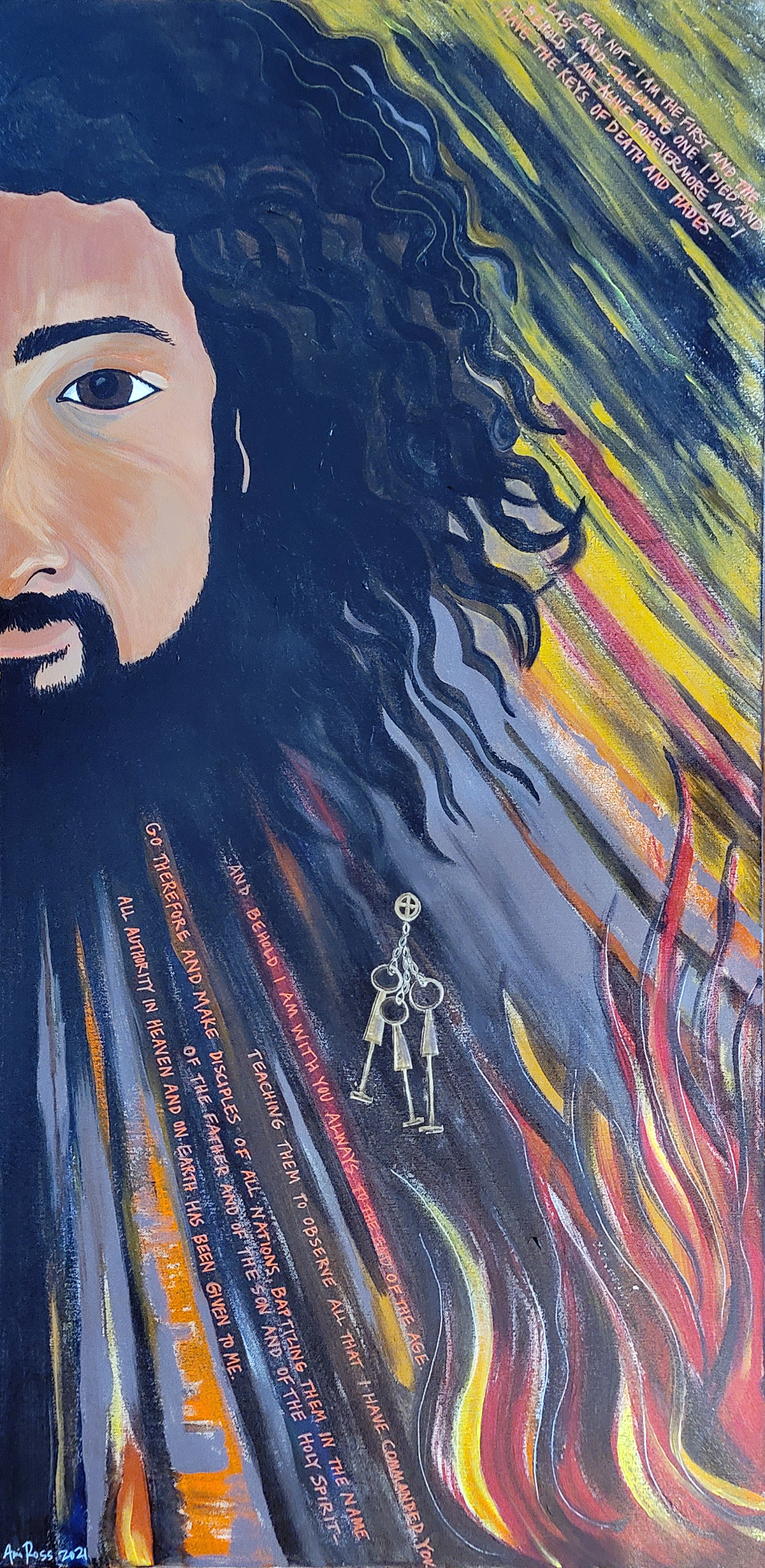
One way we at BSF Headquarters have responded is by creating BSF Galleries that connect to our studies. We are not looking to create photorealistic pictures of Scripture (because no one knows exactly what biblical events looked like). Rather, we wanted artistic expressions inspired by God’s Word. That is why we asked professional artists in the BSF family from around the world to read, meditate upon and pray over their chosen passage.  

Then they worked. They created. They produced what you ultimately see displayed in the gallery. 

Like in the previous Genesis study, the works in the new Matthew gallery are meant to be expressions of worship that inspire worship in others. The artwork is not meant to be viewed literally or to take the place of reading Scripture. They are one person’s perspective – potentially from a radically different cultural context than your own – sharing how God spoke to them through His Word. 

Most of you share in your discussion group how God speaks to you by using words. These artists are doing the same thing through a visual medium. 

Our hope is the art galleries will first and foremost glorify God. Our prayer is they will drive you to worship and to see Scripture in a fresh way that breathes new life and meaning into stories you might have read a hundred times. 

The gallery also serves as a colorful example of how we are knit together into a beautiful tapestry with our brothers and sisters in Christ from around the world who see things from various cultural perspectives. Ultimately, that’s a wonderful, beautiful thing that can only be created by the Spirit of Almighty God. 

Matthew 28

By Ami Ross, USA

Bryan Belknap

BSF Creative Director

Bryan Belknap serves as Creative Director at BSF, leading a team of creative professionals designing the videos, marketing, social media, graphic design and events that serve, encourage and inspire Bible Study Fellowship’s members and leaders. Prior to joining BSF, Bryan was an award-winning screenwriter, producer and director working for companies as far-ranging as Group Publishing, LIONSGATE, Lifeway, SONY, and DreamWorks. Bryan, a second generation BSFer, and his wife Jill are both proudly watching their son continue the BSF tradition.


Pin It on Pinterest